You have got the interview. Out of every application they received, they picked you to talk to. What happens next is not about becoming a different person in a week. It is about turning what you already know — your work, your decisions, your reasons for wanting this job — into answers you can actually say out loud when your heart is beating a little faster than usual.
Most interview advice fails for a simple reason: it tells you what to do, but not when. So people cram everything into the night before, memorise long answers, and walk in sounding like they are reading a script. This plan does the opposite: it spreads the work across seven days, front-loads the thinking, and saves the last day for logistics and rest. About an hour a day is enough.
Quick answer
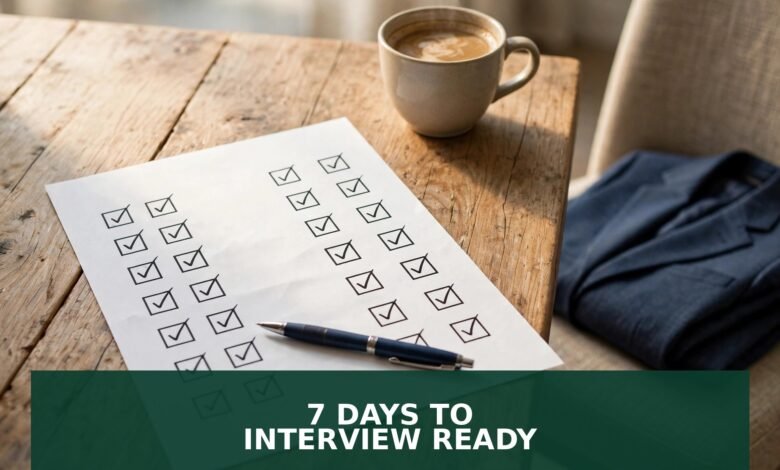
Good interview preparation takes about seven days, roughly an hour a day: Day 1, research the company and role; Day 2, turn the job description into your syllabus; Day 3, build a bank of real stories; Day 4, practise your opening answer out loud; Day 5, run a full mock interview; Day 6, prepare your questions and handle awkward topics; Day 7, sort logistics, review lightly, and stop. The highest-value habit here is speaking your answers aloud — the interview tests saying, not thinking.
Day 1: Research like an insider, not a tourist
Start with the company, not with yourself. Read what they sell, how they make money, and what they have been talking about lately. One specific, recent fact used naturally is worth an hour of generic praise.
Then read the job description again, slowly, with a pen. Highlight every capability it names: the tools, the tasks, the qualities. That list is your interview syllabus — most of their questions will map straight onto it, because interviewers usually work from the same document. Mention of difficult customers means a question about a difficult customer; mention of deadlines means a question about a deadline.
Finally, look up the practicalities: who is interviewing you, the format, and how long it lasts. A panel, a one-to-one chat, and a video call each reward slightly different preparation.
Day 2: Turn the job description into your story bank
Today you build the raw material for almost every answer you will give. Write down six to eight short stories from your real experience — work, volunteering, study, a part-time job — covering pressure, conflict, failure, initiative, teamwork, and leadership. Each story needs only four beats: the situation, what you were asked to do, what you did, and what happened. Keep each one under two minutes when spoken.
Now map each story to the capabilities you highlighted on Day 1. If a capability has no story, find a smaller, real example: organising a family event on a tight budget is genuine evidence of planning, and covering a colleague’s shift at short notice is genuine evidence of reliability. Interviewers care about what you did and what changed, not whether the setting was glamorous.
If you have no work experience at all, this day still works. Coursework, group projects, part-time work, caring responsibilities, and volunteering all contain real decisions and real results. The mistake is inventing experience; the fix is looking harder at the experience you already have.
Day 3: Your opening answer and the questions you know are coming
Almost every interview opens with some version of “tell me about yourself,” and it is the easiest answer to get wrong by rambling. Build a 60 to 90 second version with three parts: where you are now, what brought you here, and why this role is the next step. Practise it until it sounds like you talking, not you reciting. Interviewers remember a tight opening far longer than a complete life story.
Then prepare short, honest answers for the questions that come up in nearly every interview: why this job, why this company, your greatest strength, and your greatest weakness. For the weakness question, pick something real but manageable, and say what you are doing about it. “I used to avoid speaking up in meetings, so I started preparing one point in advance” is an answer. “I am a perfectionist” is not.
Write these answers down, but do not memorise them word for word — memorised answers collapse on the first unrehearsed follow-up.
Day 4: Practise out loud (the step everyone skips)
This is the day that separates prepared candidates from candidates who merely read about preparation. Stand up, set a timer, and answer questions aloud — to a friend, a family member, or your phone’s voice recorder. You will discover things silent reading never reveals: the answer that sounded brilliant in your head takes three minutes to say, and the story you thought was clear has a hole in the middle.
Record yourself at least once. You do not need to enjoy watching it; you need to notice the filler words, the rushed ending, and the moments you trail off. Fix one thing per run. Two or three short practice rounds beat one exhausting marathon.
Free AI mock-interview tools can ask you questions and give you a transcript to review. They are useful for rehearsal, but treat their scores with caution — a real interviewer is judging whether they want to work with you, not awarding marks.
Day 5: The full dress rehearsal
Run one complete mock interview under realistic conditions: the clothes you plan to wear, the same format as the real thing. Ask your practice partner to include one question you have not prepared for. Handling an unexpected question calmly is a skill you can practise: pause, then answer the question you were actually asked.
End the rehearsal by asking for honest feedback on three things only: clarity, length, and confidence. Three clear notes give you something concrete to fix on Day 6.
Day 6: Your questions, the awkward topics, and salary
Prepare three questions to ask them: what success looks like in the first three months, what the team is working on right now, and how they support someone new. Avoid questions their website already answers, and save holidays and perks for later.
Today is also the day to prepare for the topics you have been avoiding. A gap in your employment, a job you left quickly, a qualification you do not have — prepare one calm, factual sentence for each, then move on. Interviewers notice evasiveness far more than they judge an honest gap. If salary comes up, know the realistic range for the role beforehand, and have a simple answer ready rather than improvising a number under pressure.
Day 7: Logistics, light review, then stop
The last day is for lowering risk, not learning new material. Confirm the time, place, and format. For an in-person interview, plan your route and aim to arrive in the area 20 minutes early, at reception 5 to 10 minutes early. For a video interview, test your camera, microphone, internet, and lighting today, not five minutes before the call.
Lay out your outfit tonight, pack what you need — copies of your CV, a notebook, a pen, water — and re-read your story bank and your three questions once. Then stop. Cramming past this point trades composure for marginal recall. Eat properly, sleep well, and say your opening answer aloud once in the morning so the first delivery of the day is not the one that counts.
Only got 3 days? Or just 1?
Life rarely gives you a perfect week. If you have three days, keep the order and compress: Day 1, research plus story bank; Day 2, practise out loud plus mock interview; Day 3, logistics and light review. If you have only one day, spend one hour picking your four strongest stories, one hour on the company’s current priorities, and one hour rehearsing aloud — especially your opening answer. A candidate who can say four good stories clearly will always beat one who skimmed twenty articles and can say none of them.
Five mistakes that undo good preparation
- Memorising word-for-word answers. They sound rehearsed, and they fall apart on the first follow-up question.
- Preparing only answers, never questions. Having nothing to ask when they invite your questions reads as disinterest, however good your answers were.
- Badmouthing a previous employer. Even when you are right, it makes interviewers wonder what you will say about them.
- Skipping the tech check for video interviews. A frozen camera in the first minute sets a tone no great answer fully repairs.
- Arriving with no knowledge of the company. It is the one failure interviewers forgive least, because it was entirely preventable.
Frequently asked questions
How many days before an interview should I start preparing?
Seven days, at about an hour a day, lets you research, build stories, and rehearse without cramming. Three days works if you keep the same order, and even one focused day beats a panicked night-before session.
What is the best way to practise interview answers?
Out loud, timed, and recorded at least once. Silent reading feels productive but does not train the skill the interview tests: speaking clearly under mild pressure. A friend asking real questions is best; a voice recorder is a good second choice.
How do I prepare for an interview with no experience?
Use real evidence from study, volunteering, part-time work, or caring responsibilities, structured as situation, action, and result. Interviewers look for how you think and act, not a long job history, and honest small examples beat invented big ones.
What should I do the day before my interview?
Confirm the time and format, test your technology for a video call, plan your route for an in-person meeting, lay out your outfit, pack your documents, review your story bank once, and rest. The day before is for removing surprises, not new material.
What questions should I ask the interviewer?
Ask about success in the first three months, what the team is focused on right now, and how they support new starters. Three thoughtful questions are plenty, and they should show you listened rather than reciting a list found online.
Conclusion
Interview preparation is not about predicting every question. It is about arriving with a handful of real stories you can tell clearly, a genuine understanding of the company and the role, and the calm that comes from having said your answers aloud already. Seven days, an hour a day, in this order — research, stories, opening answer, spoken practice, dress rehearsal, questions, logistics — and you walk in sounding prepared because you are.
For your next steps, read our guides on strengths and weaknesses answers that do not sound fake, tell me about yourself sample answers, and behavioural interview questions with STAR answers.
FREE Website: Put Your Interview Success to Work With Your Own Website
Getting the job is step one. But what if the next opportunity — a freelance client, a side project, a better role in a year — comes looking for you online first? That is where a simple personal website earns its keep: your experience, your work, and a way to contact you, all in one place you control.
 🌐
Free Website
🌐 FREE Website — Turn Your Ideas Into Income
Disclosure: This article contains an affiliate link. If you purchase hosting through it, we may earn a commission at no extra cost to you.
And if you want to earn a handsome amount monthly over time, make a website and start writing helpful articles on it. Google traffic can turn into monthly income for people who publish consistently useful content — not overnight magic, and never a guarantee, but a steady path that rewards patience and useful writing, exactly like a career does.
Buy hosting through our link, send us your receipt through the JobyRoz contact page, and we will guide your basic business website setup for FREE. Disclosure: This article contains an affiliate link. If you buy hosting through it, we may earn a commission at no extra cost to you.

Your Toughest Mock Interviewer Fits on Your Lap
 🐶
Free Pet Guides
🐶 Love Dogs Too?
Planning your next move? Work out what a new salary really means with the money calculators at Earnrove, and keep a clear head for interview morning with Clearove.
🧮Money Tools
Earnrove - Money Tools That Just Work