
How to Explain Being Fired in an Interview in 2026: The 3-Bucket Script System That Turns It Into a 20-Second Answer

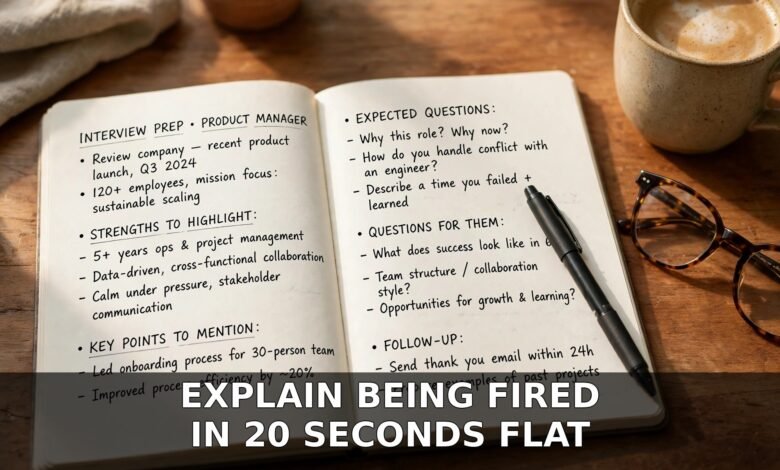
It is the question every fired job seeker dreads, and it comes in the first ten minutes: “So, why did you leave your last job?” You have two bad options — the long, defensive story, or the short, vague dodge. Interviewers are not deciding whether the firing was fair. They are asking three practical questions — will this happen again here, will your references back up your story, and can you do this job without drama? Answer those three in about twenty seconds, and the conversation moves on.
This guide gives you a system: find your bucket first, build one 20-second answer from it, fix what your resume says, and know what to do when they push for more. Five scripts are included, one for each reason people get fired.
The quick answer
Your answer has four beats, in this order, in about twenty seconds. Fact: one neutral sentence about what happened. Ownership: one sentence owning your part, with no blame. Lesson: one concrete thing that changed since. Forward: one sentence tying it to this job. Example: “I was let go in March after I missed two quarterly targets during a reorganization. I owned the miss, rebuilt how I forecast, and my contract work since has hit every deadline. This operations role fits because the goals and scope are clear from day one.” Then stop talking.
Step 1: Find your bucket before you write a word
Most terminations fall into one of three buckets, and your script changes completely depending on which one you are in.
Bucket 1: Performance, metrics, or policy. A quota miss, a failed probation, a write-up, an attendance problem, a broken rule. A paper trail exists, so this bucket needs the most ownership.
Bucket 2: Restructure, elimination, or business closure. Your role was cut, the team was reorganized, the company closed a site. No apology needed — this is a layoff.
Bucket 3: Fit, culture, or mutual mismatch. You were fine at the work but wrong for the role or the team — no paper trail, no targets missed, just a bad match.
How do you tell? Read your paperwork first: your separation letter, your final review, any settlement agreement. Then run the reference test — if you called your old manager today, what would they say? A missed target means bucket 1, a cut role means bucket 2, solid-but-wrong-fit means bucket 3. Build from that bucket, not the one you wish you were in.
The 20-second script: four beats, no more
Write it on paper and time it. Past 45 seconds, cut it in half.
Beat 1 — Fact. One clause, neutral words: “I was let go from [Company] in [month and year] after [one factual reason].” Never say “I left to pursue other opportunities” — the background check will find the gap.
Beat 2 — Ownership. One sentence, no blame: “I own my part in that.” Not “my manager had it in for me,” not “the targets were impossible.” The interviewer hears blame as a warning sign: this person will blame us next.
Beat 3 — Lesson. One concrete change, with proof: a course, a new process, stable attendance. “I learned” without evidence is a platitude.
Beat 4 — Forward. One sentence tying the lesson to this job: “This role fits because…” and then something real from the job ad. Then pause.
Five scripts, by reason — with the bad version first
Replace the details with your own, and keep them true.
1. Fired for performance. Bad: “They fired me because the new director hated me and moved my projects.” Good: “I was let go after I missed two quarterly targets during a reorganization. I owned the miss, rebuilt my forecasting, and my contract work since has hit every deadline.”
2. Fired in a restructure. Bad: “They let the whole team go, I don’t really know why.” Good: “My role was eliminated in March when the company closed our regional office — my manager will confirm the role was cut, not my performance.”
3. Fired for fit. Bad: “The culture was toxic and nobody there liked me.” Good: “My manager and I agreed I was not the right fit for a role that had become mostly outbound sales. Since then I have focused on account work, where my retention numbers were strongest.”
4. Fired for misconduct or a broken rule. This one needs the most directness. Bad: “It was one mistake, everyone does it, HR overreacted.” Good: “I was let go after I missed three shifts in one month without calling in. That was my responsibility — I changed my childcare cover and have not missed a shift since.”
5. Fired during probation. Bad: “They never trained me properly, so how was I supposed to pass?” Good: “I was let go at the end of a three-month probation because I was not hitting the onboarding pace they needed. I asked for the gaps, worked on them, and my last manager will tell you my ramp-up was fastest.”
What goes on the resume — and what stays verbal
On the resume, show the employer, the title, the dates, and bullets that prove scope. Never write “terminated for performance” on it — the explanation stays verbal, in the interview.
Two rules. First, match your resume dates to what HR will verify — dates that do not match the application form trigger the termination question early. Second, keep the bullets honest and strong: a firing does not erase the work you did. The resume sells what you can do. The interview explains the ending.
If the gap between roles is the problem, read our guide to explaining an employment gap in an interview — the two answers must not contradict each other.
Application forms and reference checks
Some applications ask outright. In the US, the federal Declaration for Federal Employment asks whether, in the last five years, you were fired from any job for any reason. Answer truthfully — a false statement on a federal form is a far bigger problem than a firing. For private employers, never lie on a form, and never invent a reason your reference will contradict: verification usually confirms titles and dates, not the reason for leaving, but a reference check covers performance, attendance, and whether they would rehire you. That is why the bucket test matters — your script must match what the reference will say. If you are not sure what your old employer will say, ask.
Check any separation agreement before you describe the departure, and get legal advice first if you believe the firing broke the law. This guide is general information, not legal advice.
US vs UK: what changes across the Atlantic
The script works the same in both countries; the law does not.
In the US, most employment is at-will: an employer can end it for almost any reason that is not discriminatory or retaliatory.
In the UK, an employee generally needs two years of continuous service to claim ordinary unfair dismissal — and that is changing. From 1 January 2027, protection becomes a right after six months, and the compensation cap is removed. If you were dismissed recently, check your length of service and the date. Some claims, like discrimination, need no qualifying period. Statutory notice still applies: one week if you worked there between one month and two years.
UK references work differently too: an employer need not provide one, but any reference given must be accurate and based on facts. The same 20-second script applies; do not call the dismissal unfair unless you have taken advice.
When they push for more: the follow-up drill
A good interviewer will ask one follow-up. Rehearse these three out loud.
“Tell me more about what happened.” Give one more sentence of fact, then repeat the lesson. Do not add new grievances.
“Would your old manager agree with that?” Say yes, and mean it — this is the question the bucket test was for. If your old manager would not agree, your script is in the wrong bucket.
“What would you do differently?” Answer with the concrete change: “I would flag a slipping target in week two instead of week six. That is the process I built, and my last three projects landed on time.”
Then the 10-minute drill: write the script, read it out loud, time it — twenty seconds is the target, forty-five is the ceiling. Say it once to a friend, then once from memory. If you can say it calmly, without notes, in under a minute, you are ready.
Frequently asked questions
Should I tell an interviewer I was fired?
Yes — honestly, briefly, in your own words, before they find out another way. A firing you explain in twenty seconds is a fact about your past; one they discover from a background check is a lie about your present. Never put the reason on your resume.
How long should my answer be?
About twenty seconds, never more than forty-five: fact, ownership, lesson, forward. If they want more, they will ask. A two-minute answer sounds defensive.
What if I did something wrong?
Say what you did, take responsibility, and give evidence it has changed. Interviewers expect mistakes; what they test is if you learned. A concrete change — a new process, training, eight months of clean attendance — beats any apology. Do not blame the company.
Can a new employer find out I was fired?
Usually, yes. Verification confirms your title and dates, and a reference check can surface performance and attendance. Federal applications in the US ask directly about firings in the last five years. Assume they will know, and make sure your version matches your old employer’s.
What if I was fired unfairly?
Say so plainly, once: “I believe the dismissal was unfair, and I am taking advice on it.” Then pivot to the work. In the UK, check your length of service — two years now, six months from 1 January 2027 — and note that some claims, like discrimination, need no qualifying period. If you signed a separation agreement, read it first.
Conclusion
Being fired feels like the interview is already lost. It is not. What interviewers remember is the thirty seconds after the question — if you rambled, blamed, or lied, or gave a short, honest answer with proof behind it. Find your bucket, build the script, and practice it once.
Start tonight: write the four beats on paper, time yourself, and say it once from memory. That is how to explain being fired in an interview without the answer becoming the interview. For the rest, see our Remote Jobs guides — handling job rejection, handling multiple job offers, the tell me about yourself formula, and following up after an interview.
Your Interview Answer Is Ready — Now Let Your Business Speak for Itself
A twenty-second answer can change how an interviewer sees you. A business website does the same thing — it is the proof that speaks before you ever sit down, showing people what you do before they hear a word from you. And just like the script above, it doesn’t need to cost a fortune or take weeks. Today it’s simple: buy hosting through our link, tell the built-in AI about your business, and the AI builds the website for you. No coding, no designer, no technical skills needed.
 🌐
Free Website
🌐 FREE Website — Turn Your Ideas Into Income
Disclosure: This article contains an affiliate link. If you purchase hosting through it, we may earn a commission at no extra cost to you.
And if you’d like to earn a handsome amount every month, a website is one of the most honest ways to start: write helpful articles on it, let Google bring readers, and let that traffic turn into monthly income over time. It takes consistent articles, not overnight magic — nobody can promise you earnings, and neither do we. But every week you publish is a week your site works a little harder for you.
Buy hosting through our link, send your receipt via the JobyRoz contact page, and we will guide your basic business website setup for FREE.
Disclosure: This section contains an affiliate link. If you buy hosting through it, we may earn a small commission at no extra cost to you.

The Only Coach Who Thinks Your Comeback Story Is Brilliant
He has been lying on your interview notebook for an hour, chin on the page, convinced you have already got the job. No judgment about the last one, no questions about the gap — just total faith that the next interviewer will see what he sees. Fancy a coach like that?
 🐶
Free Pet Guides
Before you go, two more free tools: work out what the next job is really worth with the free salary and take-home pay calculators at Earnrove, and check what is actually in your tap water with the honest guides at Clearove.
🧮Money Tools
Earnrove - Money Tools That Just Work