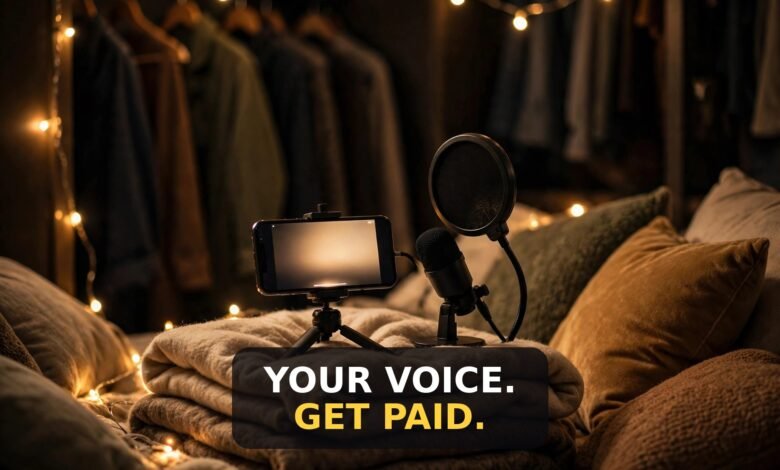
Somewhere in the world it is already past midnight, the house is finally quiet, and you are up wondering if there is a real way to earn from home that does not involve another spreadsheet. There is one sitting on your face. Your voice. Not a “movie trailer voice” — just the normal, human voice you use to explain things to friends. Companies pay for that every day: YouTube narrations, explainer videos, online courses, podcast intros, product ads, audiobooks.
Most people get voice over work wrong. They think you need years of acting training or a fancy studio. You need neither to start. You need a quiet corner, a phone or basic mic, one short demo reel, and the patience to be ignored by the first twenty clients you pitch. That last part is the part nobody puts in the headline. Let us fix that.
Quick answer
How do beginners start voice over jobs from home with no experience? Record a 60-second demo reel with 3–4 short samples (commercial, narration, conversational) using your phone or a basic USB mic in a quiet closet, then list your services on Fiverr, Upwork, or Casting Call Club and audition daily. Beginner gigs commonly pay $5–$25 each on marketplaces — rates vary by platform and gig, nothing guaranteed. Expect your first client within weeks if you audition daily; most beginners quit because they audition ten times and stop.
What voice over work actually looks like for beginners
Forget Hollywood. A beginner’s voice over day is small, ordinary, and paid per job:
YouTube and social narration. Faceless channels need a human voice — “top 10” videos, finance explainers, story channels. The most common beginner gig on Fiverr: a 3-minute script, recorded at home, delivered as an MP3.
Explainer and e-learning narration. Small businesses and course creators pay for clear, friendly narration over slides and product videos. If you sound natural explaining something in simple words, you fit here.
Commercials and ads. Beginners rarely book national ads — you start with the small stuff: a 30-second spot for a dental clinic or a mobile game ad. Small stuff pays and builds your portfolio.
Audiobooks (ACX). Amazon’s ACX connects narrators with authors. Beginners can start with royalty-share projects — no upfront pay, a share of every sale. Long hours though: one finished hour takes roughly 5–6 hours of beginner work, so start with short books.
All of it is remote and night-friendly. Record when the house is quiet, deliver by morning. A client in New York sends a script at noon, you record it at midnight your time — this is genuinely worldwide work.
The honest money talk: what beginners really earn
This niche is full of liars, so here is the truth. Those “$100–$500 per project for beginners” posts describe experienced artists with portfolios — not your first month.
First gigs (Fiverr, Casting Call Club): $5–$25 per finished job for short scripts. This is where you collect your first 10–20 reviews. It is not about the money — it is proof you can deliver.
After 20+ reviews (Upwork, repeat clients): $25–$100 per short project. Clients come back because you are reliable — reliability is rarer than a beautiful voice.
Experienced (direct clients, voices.com, voice123): $100+ per project. Real numbers, but freelance income stays per-gig and inconsistent — never guaranteed.
The one thing that moves you up this ladder fastest: auditioning volume. Ten auditions a week minimum when you are starting. And before planning around any number, run your real math through an earnings calculator at Earnrove.com — gigs per week you can actually do times your starting rate. Honest math beats hopeful math.
What you actually need to start (and what to skip)
Beginners burn money here. So: do not buy a studio.
Day one: your phone and the voice memo app. A smartphone mic is genuinely good enough for your first demo reel and first paid gigs, as long as the room is quiet.
The closet trick. Record inside a closet full of clothes, or surround yourself with pillows and blankets. Clothes absorb the echo that makes home recordings sound “amateur.” Studios spend thousands on acoustic treatment; your wardrobe does 80% of it for free.
Free editing: Audacity — free, and it does everything a beginner needs: cut silences, remove background noise, normalize volume. One weekend of tutorials and you can edit like a pro.
Your first upgrade (only after earning money): a basic USB mic and a cheap pop filter — bought with gig money, not savings. That keeps the whole thing risk-free.
Beginner gear picks (buy only with gig money, not savings)
As an Amazon Associate, JobyRoz may earn from qualifying purchases — at no extra cost to you.
Once paid gigs have covered the cost, these are the only upgrades worth considering. Nothing here is needed on day one — your phone and a quiet closet come first.
 FIFINE K669B USB Microphone
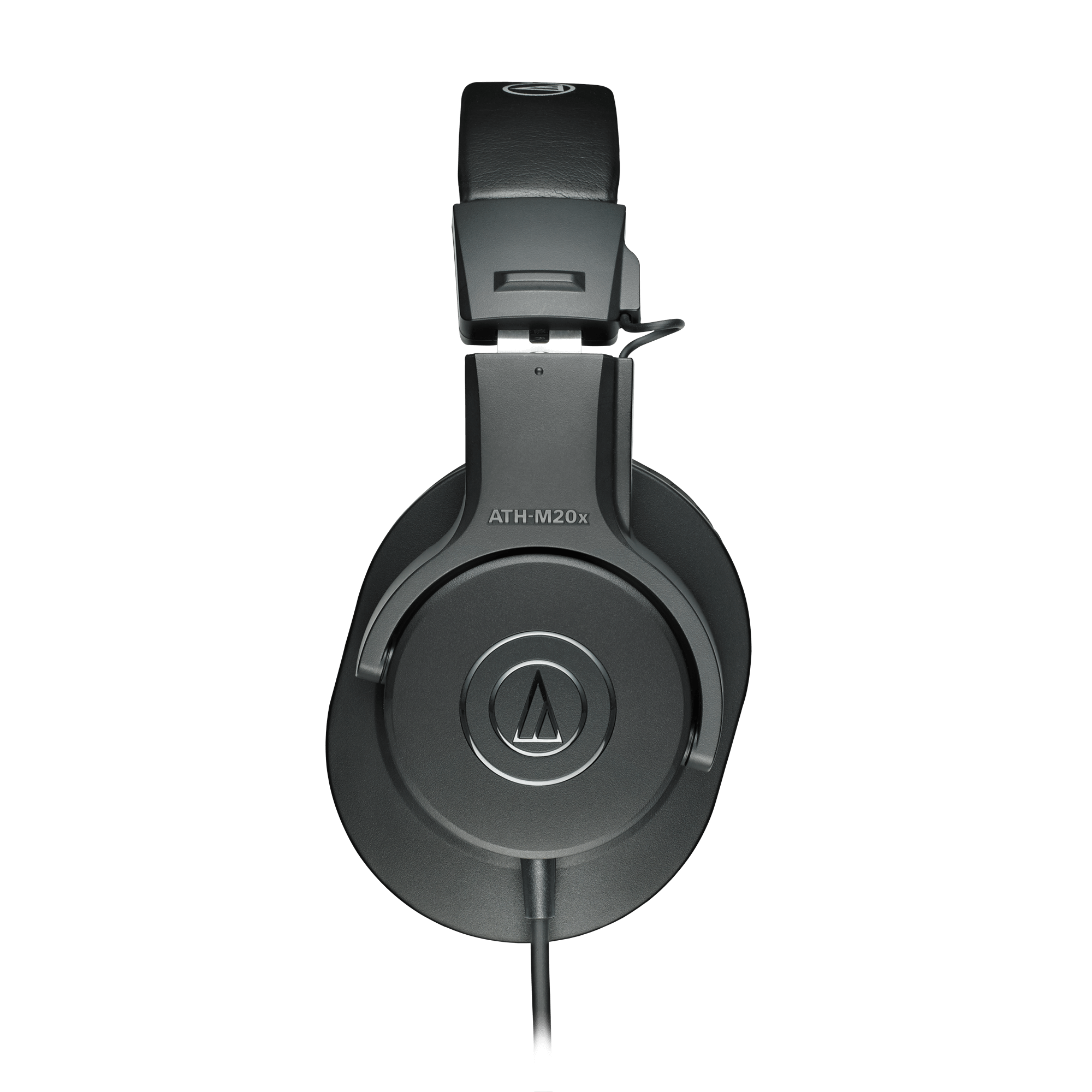 Audio-Technica ATH-M20x Studio Headphones
 Neewer Pop Filter
 InnoGear Mic Boom Arm
 MAONO AU-A04 USB Mic Kit
Skip for now: expensive XLR gear, paid “voice over courses” before your first gig, and monthly-fee casting sites. Upgrade when income justifies it.
Your demo reel in one evening
Your demo reel is your entire résumé. One rule matters most: clients decide within the first 5–10 seconds whether to keep listening. Front-load your best sound.
Keep it to 60 seconds. Three to four short clips, no music bed, no effects — clean voice only.
Show three tones. Friendly commercial (imagine selling coffee). Calm narration (explaining a product). Warm storytelling (a children’s book opening). That covers 90% of beginner gigs.
Write your own practice scripts. Read a product page out loud. Narrate a recipe. Real-world words sound real; theatrical “demo scripts” sound like school plays.
Record after dark. Night recording is genuinely better: traffic gone, house asleep, silent. Your closet at 11 PM sounds more professional than your living room at noon.
You will hate your voice the first time on headphones — everyone does. By the tenth take, you will be used to it. That is not a joke; it is how your brain works.
Where your first paying gigs come from
- Fiverr — one clear gig (“I will record a professional voice over for your video”), priced low to start, delivered fast. The algorithm rewards completed orders: volume first, price later.
- Upwork — bid on small voice jobs daily. Proposals that mention the client’s actual project beat templates every time.
- Casting Call Club — free to join, loads of small paid and unpaid gigs. Unpaid ones still build your portfolio reel — the actual currency here.
- ACX (Amazon) — audiobook narration. Start with short royalty-share books to practice long-form without pressure.
One source beginners ignore: your own network. Local businesses need voicemail greetings and promo videos. One email to five local businesses (“I do affordable voice overs — here is a 30-second sample”) can land your first real client before Fiverr ever does.
5 mistakes that stall beginners
1. Auditioning ten times, then quitting. The number one killer. People who book work audition daily for months. Treat auditions like a second job.
2. Waiting for “the perfect voice.” Clients want real, warm, believable — the over-polished “radio voice” era is over. Conversational wins.
3. Recording in an echoing room. A $500 mic in a bare room sounds worse than a phone in a closet. Room first, gear second.
4. Sending one demo style. Only dramatic narration? You will never book commercials. Three tones minimum, always.
5. Ignoring voice health. Warm water with honey before sessions, no shouting, no whispering (it strains more than speaking), and sleep. Long recording days dry you out — keep a bottle nearby. And if you are curious what actually clean water means for daily drinking, Clearove.com covers it honestly.
Frequently asked questions
Do I need a good voice to do voice over work?
No — you need a clear, natural voice and the ability to read like you mean it. A “nice” voice with flat delivery books nothing. A normal voice that sounds warm and believable books work every week. Training helps later; it is not the entry ticket.
How much do beginner voice over artists actually make?
On marketplaces, beginner gigs commonly run $5–$25 per short job; after 20+ reviews and repeat clients, $25–$100 per project is realistic. Bigger numbers belong to experienced artists with portfolios — real, but not your starting point. Freelance income is per-gig and inconsistent.
What equipment do I need to start voice over from home?
Day one: your phone and a quiet closet (clothes kill echo), plus free Audacity for editing. That is genuinely enough for your first demo reel and first gigs. Upgrade to a basic USB mic only after gig money pays for it.
Where do beginners find their first voice over gigs?
Fiverr (one clear, low-priced gig), Upwork (daily bidding with custom proposals), Casting Call Club (free small gigs, great for portfolio), and ACX for audiobooks. Plus your own network — local businesses are often the fastest first client.
Can I do voice over jobs if I don’t live in the USA?
Yes — this is genuinely worldwide work. Fiverr, Upwork, Casting Call Club, and ACX accept international freelancers, and there is demand for English, Spanish, Hindi, Arabic, and many other languages. Check payout options in your country before you start.
Final thoughts
Voice over work is one of the few online income paths where the barrier is not money or credentials — it is repetition. Record every day. Audition every day. Improve one small thing every week. The beginners who book work are not the most talented ones. They are the ones still auditioning in month three.
Your move tonight: grab your phone, climb into the closet, and record your first 60 seconds. Then record it again — the second take is already better. While you build this skill, our guides to quiet remote jobs with no video calls and AI trainer jobs are two more no-camera income paths for the same quiet evenings.
🎙️ Your Voice Demo Deserves Its Own Website
Here is what beginners learn the moment they start pitching: before hiring you, a client googles you. A simple website with your demo reel front and center, a short bio, and a contact form is one of the strongest trust signals a new voice artist can send — honestly, a website is almost necessary today for any freelancer who wants to be taken seriously.

🌐 FREE Website — Turn Your Ideas Into Income
Want a handsome monthly income? Publish helpful articles consistently and let Google traffic grow into real earnings — steady work, never overnight magic. We never guarantee earnings.
Disclosure: This article contains an affiliate link. If you purchase hosting through it, we may earn a commission at no extra cost to you.
And if you want to earn a handsome monthly income over time, a website plus consistent, genuinely helpful articles about your voice over journey is one of the most proven routes: Google traffic can grow into monthly income, but only through steady publishing — never overnight magic. We never guarantee earnings, only the method real creators actually use.
Our offer: buy hosting through our link and send us your receipt through the JobyRoz contact page, and we will personally guide your basic website setup for FREE.
Disclosure: This article contains an affiliate link. If you purchase hosting through it, we may earn a commission at no extra cost to you.

Your Dog Already Knows Your Best Voice

Think about it: