How to Follow Up on a Job Application in 2026: The Triage-First Ladder That Gets Replies Without Pestering

You hit submit, the confirmation screen flashed, and then… nothing. No email, no call, no update. Three days pass. Then a week. If that sounds familiar, learning how to follow up on a job application is the one skill that turns silence from a dead end into a second chance.
Here is the honest truth: a follow-up will not rescue a weak application. It will help a good one get read. Ashby’s 2026 report, built on 109 million applications, found the average hire now takes 291 applications — up from roughly 100 in early 2021 — and only 3.6% to 4.7% reach an interview.
Quick answer: how to follow up on a job application?
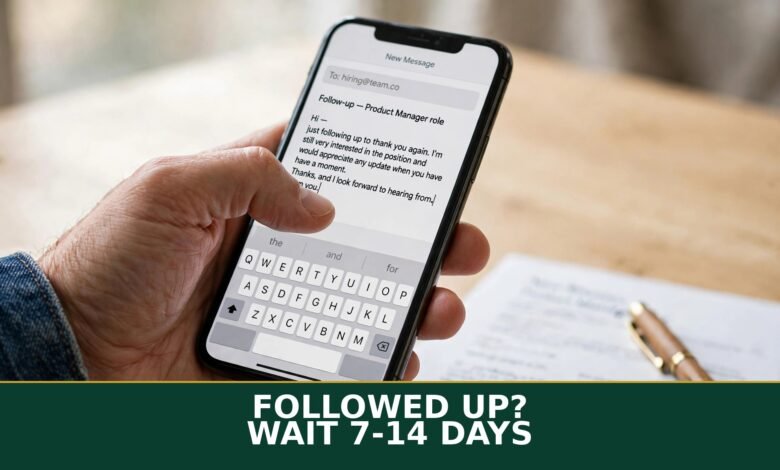
Wait 7 to 14 days after you apply, then send one short email — 50 to 125 words — to a named person: the recruiter on the posting, the hiring manager, or someone who referred you. Name the role, give one reason you fit, and ask one clear question about next steps. No reply? Send one more note a week later. Then stop. Two follow-ups is the limit. If the posting says “no calls or emails,” do not follow up at all.
Why most applications end in silence
Hiring takes far longer than most job seekers expect. Robert Half found 37% of hiring managers say three to four weeks to fill a role. A quiet first week is normal, not a rejection.
Ashby’s data shows the median time to archive a candidate who never got an interview is about six days — usually without a word. And you are not imagining the ghosting: iCIMS’s May 2026 report found 48% of entry-level applicants named not hearing back as their top frustration, and in Huntr’s 2025 survey, nearly 90% of 1,049 job seekers said they had been ghosted at least occasionally.
Step 1 — Triage first: only chase your top 3 to 5
Most job seekers make the same mistake: they apply to 40 jobs, then try to follow up on all 40. A follow-up works because it is personal and specific. You cannot be personal and specific 40 times.
Sort your applications into three piles first. Pile A — chase these (3 to 5 max): a strong fit, a role that excites you, or a company where you know someone. These get both follow-ups. Pile B — watch these: decent fit, no contact. Check the posting weekly; follow up only if it stays live past two weeks. Pile C — let these go: stretch roles and half-hearted applications.
For recent graduates sending out dozens of applications, this matters even more. Our 30-day system for finding a job after graduation shows how to balance volume and follow-up without burning out.
Step 2 — Check before you write
Never send a follow-up blind. Five minutes on four checks can change what you write — or tell you not to write.
Is the posting still live? If the job has vanished from the company’s careers page, the role is likely filled — and a follow-up looks careless.
Did the posting give a date? A closing date or a “we will be in touch by” line overrides every rule in this article. Wait until it passes.
What does your ATS status page say? Check Workday, Greenhouse, or Lever before you email. “Under review” means wait. “Not selected” means stop.
Does the posting say “no contact”? Some postings say “no calls” or “only shortlisted candidates will be contacted.” Respect it — ignoring it can get your application flagged.
Step 3 — Climb the contact ladder in this order
Who you write to matters as much as what you write. Work down this ladder and stop at the first rung that gives you a real person.
Rung 1 — Someone who referred you or works there. If a friend or former colleague referred you, ask them first — they can check internally, which a stranger cannot.
Rung 2 — The recruiter named on the posting. Many postings name the recruiter, and your confirmation email often does too. Answering you is their job.
Rung 3 — The hiring manager. If you can work out who the role reports to, write to them — shorter than the recruiter version. A three-line note beats a three-paragraph one.
Rung 4 — Last resort: a short LinkedIn message, or the general HR inbox. Never message three people at the same company about the same role. One person, one message.
Step 4 — Touch one: the 7–14 day email
Your first follow-up goes out 7 to 14 days after you applied — or one to two days after the closing date if the posting had one. In a survey of more than 300 US HR managers run by Accountemps and published by Robert Half, 36% said one to two weeks was the right wait, and none said candidates should not follow up at all. That survey is from 2017, so treat it as a guide, not a law.
Keep it short. Boomerang’s study of more than 40 million emails found messages of 50 to 125 words got a reply more than half the time. Four or five sentences is the sweet spot: the role, when you applied, one line on why you fit, and one clear question:
Subject: Following up — [Job Title] application
Hi [Name],
I applied for the [Job Title] role on [date] and wanted to check in briefly. I have spent three years doing [the one thing the role needs most]. Could you share whether there is a timeline for next steps?
Thank you,
[Your name] | [Phone] | [LinkedIn URL]
Send it between 10 a.m. and 2 p.m. local time, Tuesday to Thursday. Then leave it alone — patience is part of the message.
Step 5 — Touch two: the final nudge, then stop
If a week passes with no reply, send one more — and make it your last. Same length, different angle: add one small piece of value, like a project link or a new certification, instead of repeating the first email.
Subject: Re: Following up — [Job Title] application
Hi [Name],
Just a quick second note on my application for the [Job Title] role. Since applying, I [one fresh proof point — a certification, a small project]. If the role has been filled, no worries — I would still love to be considered for similar roles.
Thanks again,
[Your name]
After this one, stop. Two follow-ups is the limit. A third message does not show persistence, and repeated follow-ups can get an application flagged. When a follow-up lands you an interview, the rules change — our post-interview follow-up timeline covers the thank-you note and the stop rule for that stage.
Should you follow up by email, phone, or LinkedIn?
Email wins, and it is not close. In that same Accountemps survey, 64% of HR managers picked email as the best way to follow up, ahead of a phone call at 21% and social media at 1%. Nobody picked a text message. Email is professional, it does not interrupt anyone, and it leaves a paper trail the recruiter can forward in one click.
A phone call works in a few cases: the posting lists a number for questions, or the role is in sales or PR. Keep it under two minutes and never call more than once.
LinkedIn is your backup when you have no email address at all. Keep it to two or three sentences, no attachments, and never cram a follow-up into the 300-character note on a connection request.
6 follow-up mistakes that get your application flagged
1. Following up within 48 hours. It signals anxiety, not enthusiasm.
2. Following up more than twice. Two is the limit. After that, further contact crosses from persistent into pushy.
3. Following up when the posting says not to. “No calls or emails” is an instruction, not a challenge.
4. Writing a novel. A follow-up that re-sends your whole resume or runs to 400 words will not be read.
5. Sounding entitled or desperate. One calm, confident note beats three frustrated ones.
6. Following up on a job you know is closed. Check the posting first — if it is gone, move on.
What to do while you wait
Use the waiting. Keep applying — the funnel math says you will need roughly 21 to 28 applications per interview, based on Ashby’s 3.6% to 4.7% application-to-interview rate, so one application is never a plan. If a gap in your work history is making you hesitate, learn how to explain an employment gap in 20 seconds before it comes up. And practice your 60-second “tell me about yourself” answer out loud, because the follow-up that works turns into an interview fast.
Sometimes silence is the answer. Greenhouse’s State of Job Hunting report found 61% of job seekers had been ghosted after a job interview. A company that never replies to two polite notes has told you something about how it treats people.
Frequently asked questions
How long should I wait to follow up on a job application?
One to two weeks after applying, or one to two days after the closing date if the posting had one. In the Accountemps survey of 300+ US HR managers, 36% said one to under two weeks.
Is it okay to follow up on a job application?
Yes. In the same survey, 0% of HR managers said candidates should not follow up at all. A short, polite email after a week or two reads as genuine interest.
How many times should you follow up on a job application?
Twice at most: one email after a week or two, and one more about a week later. After two unanswered follow-ups, stop and put the time into other applications.
What should I say when following up on a job application?
Four things in 50 to 125 words: the role, the date you applied, one line on why you fit, and one clear question. Add your phone and LinkedIn URL.
Should I call or email to follow up on a job application?
Email first: 64% of HR managers preferred it, against 21% for a phone call. Call only if the posting invites calls or the role is phone-heavy. Never text a recruiter unless they texted you first.
Wrapping up: follow up like a professional, then move on
It comes down to three habits: triage your applications so you only chase the ones worth chasing, check the posting and the dates before you write, and send two short, polite emails — then stop. That is the whole system. And when it works, turn one down gracefully with our guide on how to decline a job offer politely. For more guides like this, browse the Remote Jobs category.
Your Next Step Could Be Your Own Website — Free Setup Help Inside
Here is something worth thinking about while those applications are out in the world: every business today needs a website, and the same is true for you as a job seeker. A simple personal website — your story, your skills, your best work, all in one place you control — makes you stand out the moment a recruiter Googles your name. And setting one up is far simpler than most people think. Buy hosting through our link, tell the built-in AI about yourself and your work, and the AI builds the website for you. No coding, no designer, no weeks of waiting.
 🌐
Free Website
🌐 FREE Website — Turn Your Ideas Into Income
Disclosure: This article contains an affiliate link. If you purchase hosting through it, we may earn a commission at no extra cost to you.
And if you want to earn a handsome amount monthly, a website can be the start of that too. Build it, then write helpful articles on it week after week, and Google traffic can slowly turn into monthly income. It takes consistent articles and real patience — not overnight magic, and nobody honest will guarantee you earnings. But the people who start now are the ones with something to show a year from today.
Buy hosting through our link, send us your receipt via the JobyRoz contact page, and we will guide your basic website setup for FREE. Disclosure: this article contains an affiliate link. If you buy hosting through it, we may earn a commission at no extra cost to you.

The Only Applicant Who Never Waits by the Mailbox
While you refresh your inbox for the fifth time today, this golden retriever has been sitting by the front door since breakfast, ears up, watching the mailbox like the postman owes him a reply. He never sends a second email. He never checks the ATS portal. He just waits — and somehow still looks hopeful.
 🐶
Free Pet Guides
Take a lesson from him:
Does your dog stare at the mailbox like it holds the answer too?
Counting the cost of the wait? Run the numbers on Earnrove’s free money calculators to see what each week between jobs really costs — and keep a glass of clean water from Clearove on your desk while you write that follow-up email.
🧮Money Tools
Earnrove - Free Money Calculators