How to Start a Cleaning Business From Home in 2026: The First-5-Clients System That Pays From Month One

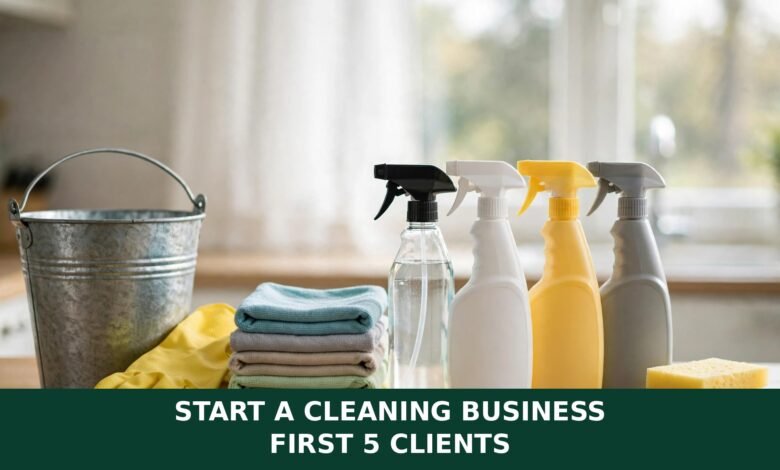
Cleaning is the least glamorous business on this site, and that is exactly why it works. No degree, no certificate — just a bucket, a vacuum, and five people willing to pay you to clean what they have no time to clean themselves. The US residential cleaning industry generates over $60 billion a year. But “anyone can do it” is also the trap: not everyone charges enough to survive, gets insured, or finds five regular clients.
Quick answer: how to start a cleaning business from home?
Pick one model — clean yourself, hire a crew, or run a referral agency — then register the business, get a local business license, buy general liability insurance ($300–$1,000 a year) and a janitorial bond ($100–$300 a year), and price standard cleans at $25–$50 an hour or $100–$200 per visit. A lean solo start costs roughly $500–$3,000. Your first five clients come from Google Business Profile, Nextdoor, property managers, and referrals — not ads.
Is a cleaning business actually a good beginner business?
For the right person, yes. Demand is steady, startup costs are among the lowest of any real business — no shop, no stock, no specialist qualification. It is physical work, evenings and weekends are when clients want you, and the first month is mostly marketing — but it pays real money from month one and can grow into a team.
The First-5-Clients System
Most guides are flat step lists: register, insure, buy supplies, advertise. That skips the decisions that decide if you make money. Here is the system, built around one worked example: a $150 standard clean of a 3-bedroom home. Five steps: model, pricing, legal kit, clients, hire or stay solo.
Step 1: Pick one of three models
Model 1: you do the cleaning. The simplest start and the most profitable per hour — you keep everything after costs. The ceiling is your own two hands: about 20–25 billable hours a week.
Model 2: you hire a crew. Cleaner wages averaged $21.01 an hour in 2026, per Indeed, with entry-level cleaners at $14–$16 and team leads at $20–$25. You earn less per job but can take ten jobs a day — but hiring, training, and workers’ comp land on you from the first employee.
Model 3: the referral agency. You own marketing, booking, payments, and customer service; independent cleaners own supplies, transport, and the cleaning. No equipment, no vehicle — you take a cut of every booking. Bryan Griffin, who built Patriot Maids into a business operating in 26 states, runs this model — his rule: 5–8 cleaners registered and available before spending a dollar on ads.
If you would rather sell a skill than a service, starting freelancing with no experience follows the same first-client logic with a laptop instead of a mop, and travel agents from home work the same agency way through a host agency.
Step 2: Price it by the 45% rule
Beginners price by guessing, and guessing usually means too cheap. The rule that separates profitable cleaning businesses from struggling ones: direct labour should not exceed 45% of revenue. Everything else fits in the other 55%.
Our worked example, a $150 standard clean:
- Revenue: $150 for one 3-bedroom home, about 3 hours of work.
- Labour: one cleaner at $18 an hour × 3 hours = $54 (36% of revenue — inside the rule).
- Supplies and chemicals: about $8.
- Travel: 20 miles at the 2026 IRS rate of $0.67 a mile = $13.40.
- Left over before insurance, tax, and admin: about $74.60.
Clean it yourself and the $54 of labour is yours too — solo operators take home $18–$30 an hour after expenses on $30–$50 an hour billed. The rates check out across 2026 pricing guides: standard cleans run $25–$50 an hour or $100–$200 per visit, deep cleans $50–$75 an hour or $200–$500+, and Housecall Pro’s 2026 data from 1.56 million jobs puts a standard clean at $140–$220 and a move-in/out deep clean at $220–$400. Prefer flat rates — and walk away under $40 an hour after costs.
Step 3: The legal kit in one afternoon
There is no special “cleaning certification” for residential work and no national business license in the US — just a small kit of paperwork, all doable in one afternoon.
Register the business. A sole proprietorship is often free to declare; an LLC usually costs under $500 online.
Get a local business license. Your city or county issues it, typically $50–$400 a year, and most areas require one. Eight states plus Washington DC also run a statewide license or registration. Get a free EIN from the IRS at the same time — it takes minutes online.
Buy general liability insurance. This is the non-negotiable one: it covers accidents like a scratched floor or a broken vase. It typically costs a solo cleaner $300–$1,000 a year for $1,000,000 of per-occurrence coverage.
Add a janitorial bond (about $100–$300 a year). It covers theft claims.
If you hire, add workers’ compensation. It is legally required in most states from the first hire, and covers medical bills and lost wages if someone on your team gets hurt. In the UK, same shape, different names: register as a sole trader or with Companies House and carry public liability insurance.
Cleaning is not the only licensed service business you can start from home — making money as a notary follows the same pattern: a small license, a small startup cost, pay per appointment.
Step 4: Your first 5 clients without ads
Five clients is a networking problem, not an advertising problem — work five channels in order: Google Business Profile (free, and where “cleaner near me” searches land; ask happy clients for reviews); Nextdoor and local Facebook groups (introduce yourself; one neighbour’s recommendation can fill a week); property managers and Airbnb hosts (one manager with twenty rentals is worth fifty flyers); flyers in the streets you want to work; and the referral ask after every first clean: “Do you know one person who might want this?”
Social media is learnable — social media managers with no experience start the same way: before-and-after photos (with permission) and nothing else.
Step 5: Hire or stay solo?
After your first five clients, you face the only decision that matters: stay solo or hire. Stay solo if you like the work and want the highest pay per hour — a solo operator billing $30–$50 an hour keeps $18–$30 of it after expenses. Hire if you want more than 25 hours a week of income: that is roughly the physical ceiling for one cleaner.
The test is simple: if you are turning down jobs, hire one cleaner, pay at least $16 an hour for entry-level work, and keep labour under 45% of revenue. If you are not turning down jobs, you have a marketing problem — hiring would only add costs to an empty diary.
The honest month-one maths
Five clients, each on a fortnightly standard clean at $150 — ten cleans in month one:
- Gross: 10 × $150 = $1,500
- Supplies and travel: about $215
- Insurance and bond (monthly share): about $90
- License and registration (first month only): about $200
- Left over, before tax, cleaning it yourself: about $995
That is a realistic first month, not a promise — most beginners take three to six weeks to land five clients. Month two is better: no license cost, and the clients repeat. The ceiling is real: a solo cleaner cannot do more than about 25 billable hours a week, so the path past $3,000–$4,000 a month runs through hiring.
If you would rather deal in products than people, flipping items for beginners follows the same buy-low-sell-high logic with no appointments to keep.
5 mistakes that kill new cleaning businesses
1. Pricing by guessing. $20 an hour “sounds fair” until travel, supplies, and insurance leave you under minimum wage — use the 45% rule. 2. Skipping insurance. One broken item without liability cover can end the business in a week. 3. Taking every job. A client an hour away, or one who haggles every visit, costs more than they pay. 4. Buying ads before you have reviews. Five Google reviews first. 5. No-shows. One missed appointment undoes ten good cleans.
Frequently asked questions
How much does it cost to start a cleaning business?
A lean solo start costs roughly $500–$3,000: registration and license ($150–$500), supplies ($400–$1,500), and the first months of insurance ($200–$600). A bigger launch with a team runs $2,000–$10,000 — start lean and buy better kit from profits.
Do you need a license to start a cleaning business?
In the US, a general business license from your city or county ($50–$400 a year) covers most areas, and eight states plus Washington DC also require a statewide license or registration. There is no national license and no cleaning certification for residential work.
How much do cleaning businesses make?
A solo cleaner billing $30–$50 an hour takes home roughly $18–$30 an hour after expenses. Business owners report anywhere from $25,500 to over $300,000 a year depending on team size and commercial contracts.
How much is cleaning business insurance?
General liability insurance costs a solo residential cleaner roughly $300–$1,000 a year for $1,000,000 of per-occurrence coverage, and a janitorial bond adds $100–$300 a year.
How do I get cleaning clients with no experience?
Start with the free channels: a Google Business Profile, Nextdoor and local Facebook groups, flyers in the streets you want to work, and property managers with rentals to turn over. Offer an introductory first-clean price, do excellent work, and ask for a review and one referral.
Conclusion: your 30-day plan
A cleaning business is not a shortcut. It is a straightforward trade: honest work, honest pricing, and clients who rebook because you showed up and did the job properly. Five regular clients turn a hustle into a business.
Week 1: pick your model and sort the legal kit. Week 2: buy the kit, set up your Google Business Profile, and tell everyone you know. Week 3: clean your first two clients and ask for reviews and referrals. Week 4: count the numbers, raise the price if the diary is full, and decide if month two is solo or your first hire. The mop is the easy part. The system is the business.
For more beginner-friendly ways to earn, browse the Online Earning guides on JobyRoz.
Want Your Cleaning Business on Its Own Website? Start Free Today
If you are serious about cleaning as a business, your own website is the step that turns five clients into fifty. A website is necessary today for every business — it is where customers check you are real, where they see your prices and your reviews, and where bookings come in while you are out cleaning. And setting one up is very simple now: just buy hosting through our link below and tell the built-in AI about your business, and the AI will make the website for you. No coding, no designer, no weeks of waiting.
 🌐
Free Website
🌐 FREE Website — Turn Your Ideas Into Income
Disclosure: This article contains an affiliate link. If you purchase hosting through it, we may earn a commission at no extra cost to you.
And here is the bigger picture. If you want to earn a handsome amount monthly, make a website and start writing helpful articles on it — the same kind of guides you just read. Google traffic can turn into monthly income over time, but it takes consistent articles, not overnight magic. Nobody can promise you a number, and we will not try. What we can promise is that a website plus steady, useful writing is the most proven path beginners have.
Buy hosting through our link, send us your receipt through the JobyRoz contact page, and we will guide your basic business website setup for FREE. That is our way of helping the readers who take the first step.
Disclosure: This article contains an affiliate link. If you buy hosting through it, JobyRoz may earn a commission at no extra cost to you.
The Dog Who Makes the Mess (and Supervises the Clean-Up)
Our golden retriever creates half the mess this business cleans up — muddy paws on the floor, fur on every sofa — and then sits beside the bucket like a foreman, supervising the whole operation. He has never held a mop. He has strong opinions about how it should be held.
 🐶
Free Pet Guides
Does your dog supervise your work too?
Before you quote your first job, run the numbers: the free money calculators at Earnrove help you work out exactly what each clean leaves you with after labour, travel, and insurance. And because every good clean ends with fresh water, the clean-water guides at Clearove are worth a look.
🧮Money Tools
Earnrove - Free Money Calculators