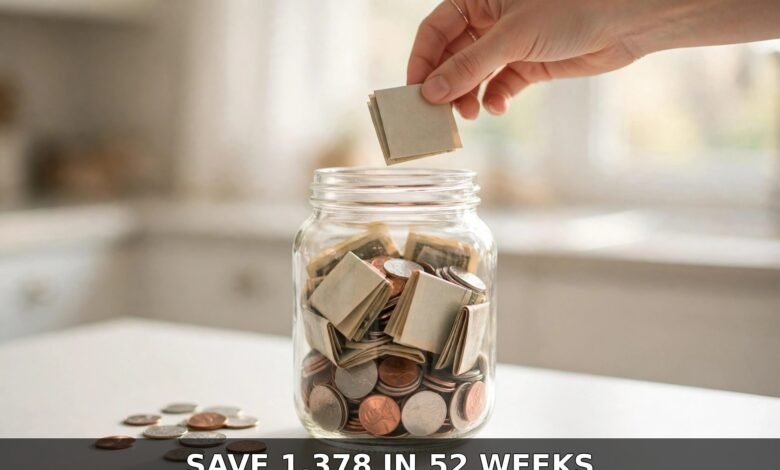
Every January, millions of people promise themselves this is the year they finally save money. By March, the promise is quietly dead — killed not by some huge emergency, but by the ordinary drift of daily spending.
The 52 week money saving challenge exists because willpower alone rarely works. It replaces motivation with mechanics: a simple weekly system that starts so small it feels silly and ends with a real chunk of money. A 911 dispatcher named Kassondra Perry-Moreland kicked off the original version back in 2013 after realizing that decades of hard work had left her with nothing saved. Her idea spread because it solved the exact problem most savers have — starting feels impossible, so the first step has to be tiny.
Quick answer: In the 52 week money saving challenge, you save an amount matching the week number — $1 in week 1, $2 in week 2, all the way to $52 in week 52. Stick with it for a year and you will have saved $1,378. You can start any week of the year, it works just as well in pounds or euros, and there are easier versions if money is tight.
How the Classic 52-Week Challenge Works
The rules fit on an index card. Each week, you move the amount of that week into savings. Week one: one dollar. Week ten: ten dollars. Week fifty-two: fifty-two dollars. That is the whole system.
The math behind the finish line is neat. Adding every number from 1 to 52 gives you 1,378 — the shortcut is 52 × 53 ÷ 2. Along the way you hit satisfying milestones: about $91 by week 13, $351 at the halfway mark, and $780 by week 39. Most people print the week-by-week chart or keep it as a phone note and cross off each line, because visible progress is what carries you through the slow early weeks.
Two details make or break it. Pick one weekday and always save on that day — payday mornings work best, before the money wanders. And decide where the money lives before you start (more on that below), because a challenge with no designated home quietly becomes one you “do later.”
5 Versions of the Challenge — Pick the One That Fits Your Life
Here is what most guides get wrong: they present one rigid version and pretend it fits everyone. A student working part-time and a dual-income couple have nothing in common financially, so they should not run the same challenge. Pick your version honestly.
1. Classic (ramp-up): $1 → $52 = $1,378. The original. Starts laughably easy and gets serious fast. Best if you are starting in January — but note the biggest weeks land in November and December, right when holiday spending peaks.
2. Reverse: $52 → $1 = $1,378. Same total, flipped. Front-load the pain while motivation is high, and December only asks a few dollars a week. The smarter play if holiday costs worry you.
3. Flat-rate: $26.50 every week = $1,378. No ramping — the same amount, 52 times. Made for irregular incomes and for anyone who wants to automate one recurring transfer and forget about it.
4. Doubled: $2 → $104 = $2,756. For dual-income households or anyone with a starter emergency fund who wants a bigger target. Pick it because the classic feels too easy, not to impress yourself.
5. Half / low-income: $0.50 → $26 = $689. The version nobody talks about enough. Six hundred and eighty-nine dollars is a real emergency buffer — the car repair or dentist visit that would otherwise go on a credit card. Finishing small beats quitting big.
You Do Not Need to Start in January
This might be the most useful paragraph in the whole guide. The challenge does not care what month it is. The math works identically whether week one falls in January, June, or October — your week 52 simply lands 52 weeks after you begin.
So start this week. Not “next month when things settle down,” because things never settle down. Pick your version, move week one’s amount today, and write your finish date on the chart. A year from now, you will either have the money or you will have the same excuses. Starting mid-year is not a compromised version of the challenge. It is the challenge.
The Missed-Week Rule: Never Restart, Never Quit
Let us be honest about something the cheerful printables skip: you will miss a week. A bill lands, the car needs work, life happens. Most savings systems die right here, because people treat one missed week as proof the whole thing failed.
So here is the only rule that matters. Do not restart from zero, and do not quit. Spread the missed amount across your next four deposits, or push your finish date back by one week. The total stays exactly the same. The people who finish are not the disciplined ones — they are the ones who refused to let a bad week become a dead challenge.
Where to Keep the Money (So You Do Not Spend It)
A savings challenge with no designated home is just a wish. You have three good options, and the right one depends on your spending personality.
A separate savings account is the best default. Money sitting in everyday checking is already spent — your brain files it under “available.” Open a free second account, and name it after your goal: “Car Insurance $1,378” beats “Savings” every time, because a named goal is much harder to raid for takeout. If your employer allows split direct deposit, route the weekly amount straight there.
The jar still works if you are a visual person — watching bills pile up is genuinely motivating. Just be honest: if cash in the house migrates into your wallet, the jar is a trap, not a tool.
Automation is the cheat code, and it is why the flat-rate version exists. One recurring weekly transfer, set up once, then runs itself. For ramp-up versions, a phone reminder on your chosen weekday costs thirty seconds of friction, once a week.
Making It Work on a Tight Income
If your budget already feels stretched, the classic chart can look like a threat rather than an invitation. Here is how to bend the challenge without breaking it.
Consider the half version or a low flat rate — even $10 a week is $520 a year you do not have right now. Fund the early weeks with found money rather than budget money: the spare change jar, a month of legit online survey sites in the evenings, one unused thing sold from a closet each month. And when a high week arrives and the budget groans, declare a no-spend week: cook from the pantry, skip the extras, and let that week’s savings come from what you did not spend.
The honest long-term play: a challenge builds the habit, but a little more income makes the bigger versions comfortable fast. Our guide to work from home jobs with no experience lists legitimate roles you can start without a résumé full of credentials — even a small side income turns the doubled version from fantasy into routine.
What People Get Wrong About the Challenge
A few honest corrections, because the internet oversells everything. The challenge is a habit tool, not a wealth strategy — $1,378 is a starter emergency fund or one big bill covered, not retirement. That is still life-changing money when the alternative is zero.
Skipping ahead is completely fine. Have a good month? Knock out a few big weeks early; the chart is a guide, not a prison. What is not fine is borrowing to fund a week — putting $52 on a credit card to “save” it defeats the entire purpose. And if you finish the year wanting more, roll straight into a second round aimed at a named goal, like a holiday fund. Savers who give the money a job keep saving; savers saving “just because” tend to stop.
Frequently Asked Questions
How much money do you save with the 52-week money challenge?
The classic version saves $1,378: $1 in week one, increasing by $1 each week, up to $52 in week 52. The reverse version saves the same $1,378. The doubled version saves $2,756, the flat-rate version at $26.50 a week saves $1,378, and the half version saves $689.
Can I start the 52-week money challenge mid-year?
Yes. The challenge works from any starting week — your week 52 simply falls one year after you begin. There is no advantage to waiting for January; starting now beats starting “properly” later.
What should I do if I miss a week?
Do not restart and do not quit. Either spread the missed amount across your next four deposits or push your finish date back by one week. The year-end total stays the same, and the challenge stays alive.
Can I automate the 52-week savings challenge?
Flat-rate versions automate perfectly with a recurring weekly bank transfer. For the ramp-up versions, set a weekly phone reminder on your chosen savings day, or ask your bank about scheduled transfers with increasing amounts. Splitting your direct deposit so part of each paycheck skips checking entirely is the most hands-off option.
Does the 52-week savings challenge really work on a low income?
It can, if you pick the right version — the half version ($689 a year) or a low flat rate fits tight budgets far better than the classic chart. Be realistic, though: the challenge builds the saving habit, it does not fix a structural shortfall. Pair it with cutting one recurring expense or adding a small side income and the results compound fast.
The Bottom Line
The 52 week money saving challenge has survived for over a decade for one reason: it turns an intimidating goal into 52 tiny decisions, and tiny decisions are the only kind most of us actually make. Pick your version — classic, reverse, flat, doubled, or half — move week one’s amount today, and give the money a home it cannot wander out of.
For a bigger-picture look at steady money habits, our Personal Finance section covers beginner-friendly systems like this one, and if you want extra cash to feed the challenge, browse low-cost work from home business ideas for realistic ways to grow your income in 2026.
FREE Website: Let Small Weekly Effort Compound Like Your Savings
You just saw how tiny weekly deposits grow into $1,378. A website works exactly the same way — one helpful article a week compounds into real Google traffic over time. And here is the thing: a website is necessary today for every business, and setting one up is very simple. Just buy hosting through our link below and tell the built-in AI about your business — the AI will make the website for you, no coding needed.
 🌐
🌐Free Website
🌐 FREE Website — Turn Your Ideas Into Income
Want a handsome monthly income? Publish helpful articles consistently and let Google traffic grow into real earnings — steady work, never overnight magic. We never guarantee earnings.
Disclosure: This article contains an affiliate link. If you purchase hosting through it, we may earn a commission at no extra cost to you.
If you want to earn a handsome amount monthly, make a website and start writing helpful articles on it — Google traffic can turn into monthly income. It takes consistent articles, not overnight magic, and nobody can promise you exact earnings. Buy hosting through our link, send us your receipt through the JobyRoz contact page, and we will guide your basic business website setup for FREE.
Disclosure: the hosting link above is a referral link. If you buy through it, we may earn a commission at no extra cost to you — and you still get the extra 20% off.

Your Dog Might Be the Reason Your Savings Keep Vanishing
One surprise vet bill — or one overpriced “miracle” pet gadget — can wipe out a month of careful challenge savings in a single afternoon. Before you spend another dollar on your dog or cat, check the honest buying guides at Furveko.com so your pet costs stop ambushing your budget. When was the last time your furry friend surprised your wallet?
 🐶
🐶Free Pet Guides
Want to see exactly what your version of the challenge saves? Run the numbers on a free savings calculator at Earnrove and pick the weekly amount with confidence. And here is one bill to shrink while you save: stop buying bottled water — a good home filter pays for itself in weeks. See how clean-water setups cut monthly costs at Clearove’s water guides.
🧮Money Tools
🧮 Earnrove — Free Money Calculators