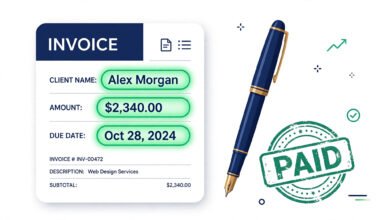
Few moments in freelancing feel worse than staring at an overdue invoice and wondering how to ask a client for late payment without sounding desperate or rude. Here is the truth experienced freelancers learn: asking for your money is not confrontation — it is administration. The freelancers who get paid fastest are not the pushiest; they are the most systematic.
This guide gives you copy-paste late payment email scripts for every stage — from the friendly nudge before the due date to the formal final notice — plus the system that makes most of them unnecessary.
Why This Feels Awful (and Why It Shouldn’t)
You did the work. The client agreed to the price. The invoice is overdue. Logically, a reminder is the most normal business communication in the world. But it feels personal, because freelancing blurs the line between business and relationship.
Reframe it: a payment reminder is a business task, like sending the invoice itself. Your client forgets, gets busy, or their accounting department loses things. In the large majority of cases, lateness is disorganization, not malice. A calm, scheduled reminder fixes disorganization. Save the stress for the rare cases that need it.
The Golden Rules of Payment Chasing
Before the scripts, five rules that make all of them work:
- Always re-attach the invoice. Never make the client hunt for it. Every reminder includes the PDF, the invoice number, the amount, and the due date.
- One clear call to action per email. “Please confirm payment by Friday” beats a paragraph of context.
- Escalate gradually. Friendly → firm → formal. Jumping straight to threats burns relationships you might want later.
- Keep everything in writing. Even if you call, follow up with an email summarizing what was agreed.
- Stay professional, always. No sarcasm, no guilt trips, no public shaming. You are collecting a debt, not winning an argument.
The 5-Stage Email Sequence (Copy-Paste)
Stage 1: Before the due date — the friendly heads-up
Send 2–3 days before payment is due. This single email prevents a huge share of late payments.
Subject: Quick heads-up: Invoice [INV-2026-014] due [Friday, June 14]
Hi [Name],
Just a quick heads-up that invoice [INV-2026-014] for [$1,200] is due on [Friday]. Attaching a copy here in case it helps with your accounting.
Let me know if you need anything else from my side!
Best,
[Your Name]
Stage 2: On the due date — the polite reminder
Short, warm, factual.
Subject: Reminder: Invoice [INV-2026-014] due today
Hi [Name],
Just a friendly reminder that invoice [INV-2026-014] ([$1,200]) was due today. Re-attaching it here for convenience.
Could you let me know when I can expect payment?
Thanks,
[Your Name]
Stage 3: 7 days overdue — firmer, with terms
Reference your agreement. Ask for a specific date.
Subject: Overdue: Invoice [INV-2026-014] — 7 days past due
Hi [Name],
I’m following up on invoice [INV-2026-014] for [$1,200], which was due on [June 14] and is now 7 days overdue. Copy attached.
Per our agreement, payment terms are Net 14. Could you please confirm a payment date by [this Friday]?
Thanks,
[Your Name]
Stage 4: 14–21 days overdue — formal notice
State consequences plainly. Mention the late fee from your invoice terms.
Subject: Formal notice: Invoice [INV-2026-014] 21 days overdue
Hi [Name],
Invoice [INV-2026-014] for [$1,200], due [June 14], remains unpaid 21 days later despite previous reminders. As stated in my payment terms, a late fee of [1.5%] per month now applies.
Please arrange payment — including the accrued late fee — by [date, 7 days out]. If there is a problem with the invoice itself, I need to hear about it now so we can resolve it.
Regards,
[Your Name]
Stage 5: 30+ days — final notice before action
Short and serious. State the next step without bluffing about steps you won’t take.
Subject: Final notice: Invoice [INV-2026-014] — 30 days overdue
Hi [Name],
This is a final notice. Invoice [INV-2026-014] for [$1,200] plus late fees is now 30 days overdue. If payment is not received within 7 days, I will [pause all ongoing work / refer this to collections / pursue formal recovery — pick what you will actually do].
I would much rather resolve this directly. Please confirm payment today.
[Your Name]
What to Do Between the Emails
- After Stage 3 with no reply: call. A phone call breaks through inbox noise. Be friendly but firm, confirm you are speaking with the right person, restate the amount and terms, and get a commitment. Then email a summary immediately.
- Check the right contact. Sometimes you are emailing a manager while accounting holds the money. Ask: “Who handles invoice payments on your side?”
- Offer a structured way out (once). If a good client is genuinely struggling, one offer of split payments can save the relationship. Never offer it twice to the same client.
How to Prevent Late Payments Entirely
The best chase is the one you never run. Prevention beats collection:
- Get terms in writing before starting — email confirmation of rate, payment terms, and late fee is enough.
- Invoice immediately — the clock starts when you send it. Same-day invoicing is a habit worth building.
- Require deposits — 25–50% upfront filters out the clients most likely to ghost you.
- Send the pre-due heads-up — Stage 1 above quietly prevents a large share of lateness.
- Make paying effortless — clear payment details on every invoice. Friction delays money.
Freelancers who do these five things report dramatically fewer overdue invoices — because most lateness was never about unwillingness, just about systems.
FAQ: Late Payments for Freelancers
How long should I wait before following up on an unpaid invoice?
Send a friendly heads-up 2–3 days before the due date, a reminder on the due date itself, then escalate weekly. Do not wait a month in silence — silence teaches clients your deadlines are flexible.
Is it rude to ask a client for payment?
No. Requesting payment for completed work is standard business communication. Polite, factual reminders preserve relationships; awkward silence followed by frustration destroys them.
Should I charge a late fee?
Yes — state it on every invoice before work begins (e.g., 1.5% per month). It is rarely enforced but noticeably speeds up payment, and it gives your later reminders real weight.
What if the client ignores all my emails?
Call them. If calls fail, send the formal final notice, pause any ongoing work, and consider collections or small-claims court for larger amounts. Document everything.
Can I stop work if a client doesn’t pay?
Yes — and you should say so in your terms upfront. Pausing work on an unpaid account is standard practice, not retaliation. State it in the contract, then enforce it calmly.
How do I avoid late payments with new clients?
Written terms before starting, an upfront deposit, immediate invoicing, and the pre-due reminder email. Four habits that eliminate most problems.
Make Late Invoices Rare, Not Routine
Chasing payments is a symptom. The cure is a tight invoicing workflow: terms agreed upfront, invoices sent the same day, numbered and tracked — so nothing slips through and reminders go out on schedule:
💸 Get Paid Faster, Chase Less — Free
- ✅ Free invoice maker — terms and late fees on every invoice, automatically
- ✅ Invoice tracking — see what’s sent, viewed, paid, or overdue at a glance
- ✅ Same-day PDF invoices — bill the hour you finish the work
Install Freelance Billable — Free
Free Chrome extension · No account needed · Your data stays on your device
 🌐
🌐Free Website
🌐 FREE Website — Turn Your Ideas Into Income
Want a handsome monthly income? Publish helpful articles consistently and let Google traffic grow into real earnings — steady work, never overnight magic. We never guarantee earnings.
Disclosure: This article contains an affiliate link. If you purchase hosting through it, we may earn a commission at no extra cost to you.
 🐶
🐶Free Pet Guides
🐾 Got a Dog at Home?
🧮Money Tools
🧮 Earnrove — Free Money Calculators