How to Budget a Biweekly Paycheck in 2026: The Paycheck A/B System That Ends the Broke-Before-Payday Cycle

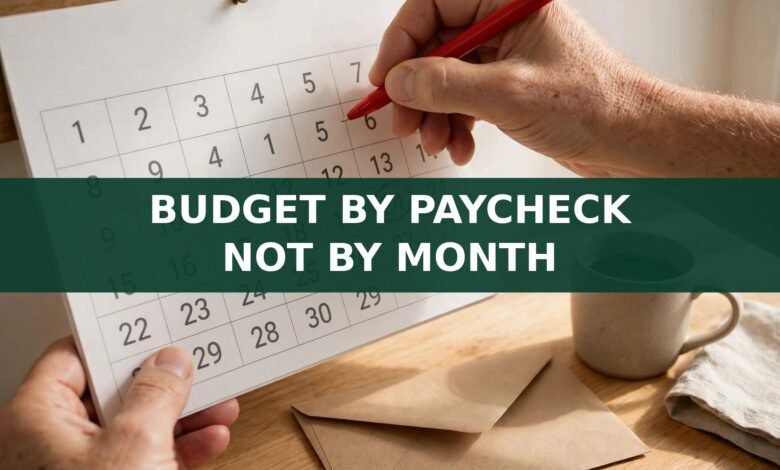
Rent is due on the 1st, but your next paycheck lands on the 3rd. You have money coming — just not in time. That timing gap is why biweekly budgeting feels so hard.
If you get paid every two weeks, your income runs on a 14-day clock while your bills run on a calendar-month clock. The two clocks never line up neatly. A monthly budget pretends they do, which is why a plan that looks perfect on paper falls apart by the second week. This guide fixes the mismatch: budget by paycheck, not by month.
Quick answer: how to budget a biweekly paycheck
Label your paychecks A and B, alternating through the year. Build your regular monthly budget on two paychecks only. Assign every bill to the paycheck that lands just before its due date, split big bills like rent in half across both checks, and give every third paycheck a job before it arrives. That is the whole system.
Why a monthly budget keeps failing you
Biweekly pay means 26 paychecks a year, not 24. Most months bring two checks, but two months a year bring three. If you multiply one paycheck by two and call that your monthly income, you are close — but if you multiply by 26 and divide by 12, you overstate what lands in your account in ten months out of twelve.
Take a $1,750 take-home check. Two checks give you $3,500 in a normal month. The 26-paycheck average is about $3,791 a month. Budgeting on $3,791 means you plan to spend $291 that has not arrived yet in every two-check month. That shortfall is exactly the gap that turns into a credit card balance by week three.
Biweekly pay is also different from semi-monthly pay. Semi-monthly means fixed dates, usually the 1st and 15th, for exactly 24 checks a year. Biweekly means every other Friday (or whatever weekday your employer uses), so your paydays drift against the calendar. A bill due on the 1st is sometimes paid from last month’s check.
Step 1: Find your real budgeting income
Start with the number that actually lands in your account, not your gross salary. Open your last three pay stubs or bank deposits. If your pay is steady, use that exact take-home figure. If it varies with overtime or hours, use the lowest of the last three checks as your planning number. You can always add a good check later; you cannot un-spend a check you assumed.
Step 2: Label your paychecks A and B
Take a calendar and mark your next twelve paydays. Label them A, B, A, B, alternating all the way through. In a three-paycheck month you will get A-B-A or B-A-B. The labels matter because every bill in this system belongs to a letter, not to a month.
Step 3: Assign every bill to a paycheck
List every recurring bill with its amount and due date: rent, utilities, car payment, insurance, phone, internet, subscriptions, and minimum debt payments. Then assign each bill to the paycheck that lands closest before its due date. The goal is two roughly balanced piles, so neither check carries a crushing load.
The trick for big bills is the half-payment method. Instead of paying $1,200 rent from a single $1,750 check and leaving $550 for everything else, set aside $600 from each check. When rent is due, the full amount is already sitting there. The same move works for a car payment, an insurance premium, or any bill that eats more than a third of one check.
Here is how the $1,750 example splits out. Paycheck A: rent half $600, car payment $320, phone $65, groceries $240, gas $100, savings $150, subscriptions $45 — $1,520 assigned, $230 left. Paycheck B: rent half $600, utilities $180, car insurance $140, internet $70, groceries $240, gas $100, minimum debt payment $150 — $1,480 assigned, $270 left. No single check faces the whole rent plus the whole car payment, and savings gets a line before personal spending.
Step 4: Build a buffer line into every check
Even a perfect A/B split breaks when a bill lands a day before payday or a tire blows out in week two. The fix is a checking buffer: a small amount you treat as zero. Start with $500 if you can, built up over a few checks, and never spend below it on purpose.
Your buffer is not savings and it is not an emergency fund. It is timing insurance — the three-day gap between a due date and a payday, the utility bill that came in higher than usual, the week groceries cost more. When you dip into it, the next check’s first job is to refill it. Readers who want a fuller safety net can pair this with a starter emergency fund — our guide to sinking funds for beginners shows how to fund irregular costs the same way, one small slice per check.
Step 5: Give every third paycheck a job in advance
Twice a year, a month holds three paychecks. If you have no plan for that third check, it melts into takeout and sale items you barely remember. Decide its job now, while it is still months away, and automate the transfer for payday morning.
A sensible order for most people: top up the checking buffer first, then the emergency fund, then an extra payment on the highest-interest debt, then a sinking fund for a known future cost. What you do not do is let the third check quietly become regular spending, because next month is back to two checks and the higher spending level stays behind.
What if your pay varies from check to check?
Hourly, tipped, and gig workers get a version of this system with one change: budget on your lowest recent check, and treat anything above it as a top-up. Say your checks run $1,400 to $1,800. Plan A and B on $1,400. When a $1,800 check lands, the extra $400 goes straight to the buffer, the emergency fund, or debt — in that order. You never re-plan your bills upward on a good check, because a short check will follow. For a full variable-income method, see our guide on how to budget on irregular income.
Five mistakes that break a biweekly budget
1. Budgeting on the 26-paycheck average. The average is real over a year and wrong in ten individual months. Budget on two checks. Let the third checks be a bonus.
2. Counting a transfer twice. Moving $300 to savings and then counting that $300 as still available for groceries is the most common spreadsheet error in paycheck budgeting. Once money moves to savings, a sinking fund, or a debt payment, it is spent for planning purposes.
3. Paying a credit card from the wrong check. Decide which paycheck pays the card, in full if possible, and put it on that check’s list. A card payment floating between checks gets paid late or twice — or not at all.
4. Never moving a due date. Most providers will shift a due date if you ask. One call can move a bill from a crowded check to a lighter one. Two or three calls can balance your whole A/B split without changing what you spend.
5. Treating the third check as fun money by default. Fun is fine, after the buffer, the emergency fund, and the debt payment have had their turn. Put the fun slice in writing too — say, $100 of the third check — so the rest still lands where it helps.
Your first-payday checklist
You can set this up tonight with a calendar, a bank app, and a notes page. Write down your exact take-home pay and your two-check monthly income. Label the next six paydays A and B. List every bill with its due date and assign it to A or B, using the half-payment method for rent and any bill over a third of one check. Set an automatic savings transfer for payday morning, even if it starts at $25. Mark your next three-paycheck month and write its job next to it. Then live on Paycheck A only until Paycheck B arrives.
Two habits keep it working. A ten-minute review on each payday: what is due before the next check, what changed, and what needs moving. And a quarterly look at subscriptions and insurance — the quiet bills that creep up while you watch the big ones. Our no spend month rules guide is a good reset if spending has drifted, and the 52 week money saving challenge pairs well with third-check months.
Frequently asked questions
How many paychecks do you get in a year if you are paid biweekly?
Usually 26. Biweekly means every 14 days, and 26 checks cover 364 days, so most years give you 26 paydays and two months with three checks. Some schedules produce a 27th check roughly every 11 or 12 years.
Should I budget on two paychecks or on the monthly average?
Budget on two paychecks. The monthly average (one check times 26, divided by 12) is higher than what you receive in ten months of the year, so budgeting on it builds a shortfall into most months. Treat third checks as extra, with a job assigned in advance.
What is the half-payment method for rent?
You set aside half the rent from each of the two checks in a month, so the full amount is ready when rent is due. It stops one check from being wiped out by a single large bill, and it works for any bill that takes more than a third of one paycheck.
Is biweekly pay the same as getting paid twice a month?
No. Twice-a-month (semi-monthly) pay lands on fixed dates, like the 1st and 15th, for 24 checks a year. Biweekly pay lands every other week on the same weekday, for 26 checks a year, and the paydays drift against the calendar. That drift is why biweekly budgeting needs the A/B system instead of a fixed monthly split.
What should I do with a third paycheck?
Give it a job before it arrives: refill your checking buffer first, then your emergency fund, then an extra debt payment, then a sinking fund for a known future cost. A small fun slice is fine once those are covered, but an unplanned third check usually disappears without helping any goal.
Conclusion
A biweekly paycheck is not a smaller income — it is an income on a different clock. Once you budget by paycheck, label your checks A and B, split the big bills in half, and decide what every third check is for before it lands, the broke-before-payday cycle loses its main cause. Start with your next check, not next month.
FREE Website: Turn Your Paycheck Plan Into a Side Income Page
Here is a thought worth sitting with: the same discipline that sorts your paychecks can quietly build a second income stream. A simple website is still the most practical way to do it — a place where your budgeting worksheets, money tips, or freelance services live in one spot that Google can find, day and night, while you are at your regular job.
 🌐
Free Website
🌐 FREE Website — Turn Your Ideas Into Income
Disclosure: This article contains an affiliate link. If you purchase hosting through it, we may earn a commission at no extra cost to you.
Buy hosting through our link, send us your receipt through the JobyRoz contact page, and we will guide your basic business website setup for FREE. Disclosure: this section contains an affiliate link — if you buy through it, we may earn a commission at no extra cost to you.

Meet the Real Reason Your Third Paycheck Disappears
He does not check the calendar, he does not split the rent in half, and he has never once asked what a three-paycheck month is for. He just looks at you like that, and somehow the extra check is gone. Give your third check its job before payday — and let the dog keep the coins he already claimed.
 🐶
Free Pet Guides
Want a budgeting buddy who never touches your buffer?
Try Earnrove’s free money calculators to check your paycheck split, and see Clearove’s clean-water guides for a healthier home while you sort your budget.
🧮Money Tools
Earnrove - Check the Numbers First