How to Budget on Irregular Income: The 2026 System for Freelancers and Gig Workers (Slow Months Won’t Scare You)

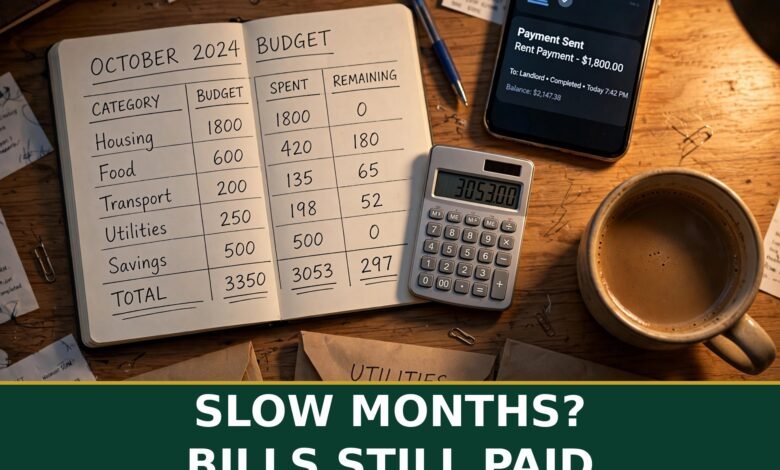
If your income looks like a roller coaster — $4,200 in March, $1,900 in April — you’re not bad with money. You’re running a steady-paycheck system on unsteady income.
Freelancers, gig drivers, and seasonal workers all face the same problem: the bills don’t wobble. Rent is rent. So how do people with irregular income make it work? With a different system — one built for variability. Here’s the six-step method that keeps every bill paid, taxes covered, and savings growing, even in stomach-drop months.
Quick Answer: How Do You Budget on Irregular Income?
People with steady income budget forward from a known paycheck. People with irregular income budget backward from a priority list — five moves:
- Find your income floor — the lowest normal month from your last 6–12 months. Your survival budget must fit inside it.
- Route every payment into a holding account first — never spend from fluctuating deposits directly.
- Move 25–30% of every payment into a separate tax account immediately — before anything else.
- Pay yourself a fixed monthly “salary” from the holding account, same date each month.
- Give surplus months a pre-written waterfall — buffer, debt, savings, then guilt-free spending.
Same system, different months. No guilt, no replanning.
Why Normal Budgeting Advice Falls Apart When Income Wobbles
Most budgeting rules quietly assume the same paycheck lands every two weeks. Run the 50/30/20 rule through a freelancer’s year: in a $10,000 feast month, $4,000 of fixed costs feel like 40% — lifestyle expands, taxes get skipped. In a $3,000 famine month, those same costs are 133% of income and the gap lands on a credit card.
Same person, same discipline, two outcomes — because the system needed a stable input that doesn’t exist. Budgeting on your average is the quieter trap: with months of $2,300 / $3,400 / $2,800 / $4,100 / $2,600 / $3,000, the $3,033 average keeps you stable in half your months. The $2,300 floor keeps you stable in all of them.
Step 1: Find Your Real Income Floor (Not Your Average)
Pull 6–12 months of actual deposits — bank statements, payment-app history, invoices. Drop the freak months (the one-off windfall, the month you were sick), and take the lowest of what remains.
$2,300 · $3,400 · $2,800 · $4,100 · $2,600 · $3,000 → floor = $2,300
That floor is your planning number: every essential bill must fit inside it. If essentials cost more than your floor month, no trick fixes that — cut costs, raise income, or both.
Step 2: Rank Every Bill by What Happens If You Skip It
Build a priority ladder — expenses in strict order of consequence:
- Survival: rent/mortgage, utilities, groceries, transport to work, insurance, minimum debt payments. Paid no matter what.
- Stability: tax set-aside, a small savings transfer (even $50 — pay yourself first even in lean months).
- Future: extra debt payoff, emergency-fund top-up, sinking funds for big predictable bills.
- Life: dining out, hobbies, fun money.
In a floor month, money may stop at rung 2. In a $4,100 month, it cascades to rung 4 — no decision fatigue, no midnight replanning.
Step 3: The Three-Account Setup
This is the mechanical heart of the system — three accounts with strict jobs:
- Income holding account — every payment lands here first. Never spend from it directly.
- Tax account — 25–30% of every payment moves here the day it arrives. Treat it as already spent.
- Spending account — your fixed monthly “salary” lands here. Daily life runs from this account like a steady paycheck.
The classic freelancer disaster is spending gross income, then discovering in April that a third of it was never yours. The tax account prevents that; the holding account manufactures your steady salary.
Paid weekly (rideshare, delivery apps)? Run a weekly version — sweep each payout through the same three buckets and give yourself a weekly allowance. Same principle, shorter cycle.
Step 4: Pay Yourself a Salary, Even If You’re the Whole Company
Pick a fixed monthly amount at or below your income floor (after the tax set-aside) and transfer it from holding to spending on the same date every month. Good months fill the buffer; lean months draw the same salary from the reserve. The variable element lives in the buffer, not your lifestyle.
Two rules: never raise your salary after one good month — wait for 3+ months of buffer and a repeating pattern. And never borrow from the tax account — raiding it turns a cash-flow wobble into a tax-season crisis.
Step 5: Give Surplus Months a Pre-Written Waterfall
Decide before the money arrives where surplus goes — otherwise a $4,100 month’s extra $1,800 evaporates into takeout:
- Income buffer — until it holds 3–6 months of floor expenses (seasonal/project income: aim for 6–12).
- High-interest debt — extra dollars against card balances are a guaranteed return.
- Sinking funds — car insurance, annual subscriptions, holidays: the predictable bills that ambush the unprepared.
- Guilt-free spending — a real step. A system with no fun gets abandoned. Cap it and feel zero guilt.
Surplus months are also perfect fuel for a structured challenge — our 52-week money saving challenge and no-spend month guides pair well with this system.
Step 6: Taxes Without the April Panic
Employees have taxes withheld before pay arrives. Freelancers get the full amount — which is why tax season destroys so many first-year independents:
- 25–30% of every payment to the tax account, the day it arrives. Recalibrate after your first full year.
- Quarterly estimated taxes. Owing $1,000+ at filing time in the US means quarterly payments (typically April, June, September, January) — painless when the money’s already set aside.
- Day-job shortcut: also earning W-2 wages? A new W-4 withholds extra from your paycheck — simpler than quarterly filings.
- Keep simple records: date, client, amount, expenses for every payment. A spreadsheet is fine — you’ll need it at tax time regardless.
(Practical mechanics, not tax advice — a tax pro is worth it in your first profitable year.)
5 Mistakes That Wreck Irregular-Income Budgets
1. Budgeting on your best month. The most-flagged gig-worker mistake: fixed costs should never exceed your lowest normal month.
2. Treating gross pay as spendable. That $1,000 payment is really ~$700 after taxes. “Forgetting” this is borrowing from your future self.
3. Upgrading lifestyle in a good month. The feast trap: a great quarter becomes a nicer apartment or car payment — fixed costs your next famine month can’t support.
4. Raiding the buffer for non-emergencies. Its one job is smoothing lean months — replenish it before upgrading anything else.
5. Waiting to save “when things stabilize.” That day rarely comes on its own — the system creates the stability. Saving $50 in a lean month beats saving $0 while waiting for a perfect one.
Frequently Asked Questions
How do freelancers budget with irregular income?
Find your income floor from 6–12 months of earnings, route everything into a holding account, set aside 25–30% for taxes immediately, and pay yourself a fixed monthly salary. Surplus months flow through a pre-written waterfall — buffer, debt, savings, then fun money.
Should I budget on my lowest month or my average income?
Your lowest normal month — the floor, not the average. The average keeps you stable in roughly half your months; the floor covers essentials every month, and anything above it becomes planned surplus instead of lifestyle creep.
How big should an income buffer be for a freelancer?
Start with 3–6 months of floor-level essentials. For project-based, seasonal, or one-client-dependent income, aim for 6–12 months — built during surplus months before any lifestyle upgrades.
How much of each freelance payment should I set aside for taxes?
25–30% of every payment, moved to a separate account the day it arrives. In the US, expecting to owe $1,000+ at filing time also means quarterly estimated payments. Adjust the percentage after your first full year.
What if my floor month doesn’t even cover my bills?
Then you’ve found your real problem — better in a spreadsheet than an overdraft notice. Cut fixed costs, raise the floor (steadier clients, an anchor gig), or both. A no-spend month buys breathing room while you fix the structure.
The Bottom Line
You don’t need your income to stabilize before your finances feel stable — you need a system that manufactures stability: a floor you trust, accounts with clear jobs, a salary you pay yourself, and a plan for good months.
Start this week: find your floor number from six months of deposits, then open that separate tax account. Slow months will still come — but now they’re a line item in your system, not a crisis.
Keep your money working with our Personal Finance guides — sinking funds, savings challenges, and systems built for real budgets.
Give Your Budget a Home Online (Free Setup Help)
The system above protects the money you have — a simple website helps you earn more of it. Clients Google you before they hire, and a clean one-page site with your services, a few samples, and a contact form turns casual referrals into paying work — for less than a week of takeout.
And it’s genuinely simple to set up today. Get 20% off hosting through our link — buy the hosting, tell the built-in AI what your business does, and it builds the website for you. No coding, no designer. Our referral code unlocks the extra 20% off.
Want a second income stream on top of client work? Build a website and write genuinely helpful articles about what you know — freelancing lessons, gig-work tips, budgeting systems like this one. Google traffic can grow into real monthly income over time. It takes consistent publishing, not overnight magic — nobody can honestly guarantee earnings, but everyone earning from content today started with one article.
 🌐
🌐Free Website
🌐 FREE Website — Turn Your Ideas Into Income
Want a handsome monthly income? Publish helpful articles consistently and let Google traffic grow into real earnings — steady work, never overnight magic. We never guarantee earnings.
Disclosure: This article contains an affiliate link. If you purchase hosting through it, we may earn a commission at no extra cost to you.
Disclosure: the Hostinger links above are referral links. If you purchase through them, we may earn a commission at no extra cost to you — it keeps JobyRoz’s guides free.

The Most Unpredictable Line in Any Budget Has Four Paws
You can budget your rent down to the dollar. You cannot budget a 2 a.m. vet bill — or the slow drip of treats and “just this once” pet gadgets eating your surplus months. Before your dog or cat turns your budget into confetti, get guidance first.
 🐶
🐶Free Pet Guides
Also in our network: run your numbers on the free money tools at earnrove.com, and if your budget still includes a bottled-water habit, see what truly clean water costs at clearove.com.
🧮Money Tools
🧮 Earnrove — Free Money Calculators