
If you spot typos in every menu, catch missing commas in novels, and quietly fix your friends’ texts in your head, there’s good news: people will pay you for that habit. Getting paid to proofread books from home is one of the quietest legit online gigs out there — no phone calls, no meetings, just you and someone else’s words.
This isn’t a get-rich story. It’s a realistic 2026 beginner’s guide: what book proofreaders actually do, what the pay really looks like, where beginners get hired without a degree, the scams to dodge, and a 7-day plan to land your first paid page.
Quick answer: Yes, you can get paid to proofread books from home as a beginner in 2026. ZipRecruiter’s October 2026 data puts average US freelance remote proofreading pay at $31.25/hour, and beginners typically start with per-word projects around $0.01/word ($500 for a 50,000-word novel) through platforms like ProofreadingServices.com, Reedsy, and Upwork — no degree required, but you’ll need to pass a proofreading test.
What does a book proofreader actually do?
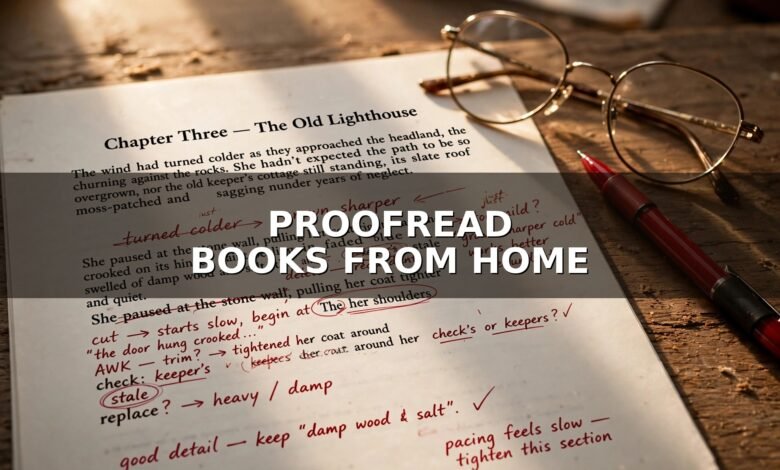
Proofreading is the last stop before a book meets readers. You’re not rewriting sentences or judging the plot — you’re hunting the small stuff that survived every other round of editing: misspelled words, doubled words (“the the”), missing punctuation, inconsistent character names, and formatting glitches.
For novels and nonfiction, the work usually arrives as a Word document or Google Doc, and you deliver your corrections with tracked changes or comments. A 50,000-word romance or self-help manuscript might take you 15–25 hours as a beginner. That sounds slow until you realize speed comes fast — most proofreaders read faster than they ever did for fun, because they’re scanning with purpose.
There’s one important split to learn early: beta reading is not proofreading. Beta readers give opinions on the story (“this chapter dragged”). Proofreaders give corrections on the text. Authors pay much better for the second one, so never let a client pay beta-reader prices for proofreading work.
How much do you really get paid?
Let’s be honest before the fun part. Beginner book proofreaders don’t bill like seasoned magazine editors. Here’s the real ladder, from multiple independent 2026 sources:
- Per-word beginner projects: around $0.01/word when you’re building reviews. A 50,000-word self-published novel works out to roughly $500. Experienced proofreaders charge closer to $0.02/word — $1,000 for the same book.
- Hourly platform rates: ProofreadingServices.com, which hires from any country, lists $19 to $46 per hour depending on turnaround speed. ZipRecruiter’s October 2026 US data shows an average of $31.25/hour for freelance remote proofreading, with most workers earning between $25.72 and $37.26.
- Per-page beginner sites: Writing Jobz pays up to $11 per page and only asks you to pass a brief language test — one of the lowest barriers anywhere.
Can it become a full-time income? The Bureau of Labor Statistics data cited by work-from-home sites puts average full-time proofreading pay around $36,960 a year. Realistic, not glamorous. And nobody reputable will promise you $10,000 a month — if a “proofreading academy” guarantees that, it’s the product, not the profession.
Do you need a degree? (Short answer: no)
No employer on the list below requires a college degree for beginner book proofreading. What they do require is proof you can catch errors — almost always a timed test. ProofreadingServices.com’s application starts with a free 20-minute preliminary test. Reedsy accepts you into its marketplace after reviewing your profile. Babbletype just asks for native-level English, basic grammar knowledge, and fluency.
That said, a short course helps you pass those tests and pitch with confidence. The respected names people mention are Proofread Anywhere, Knowadays (which also runs its own freelance marketplace for graduates), and the Chartered Institute of Editing and Proofreading. Free option that works: pull a public-domain novel, print a chapter, and proofread it with a red pen against the published version — you’ll build the exact skill the tests measure.
Where beginners find paid book proofreading work
Skip the job-board doomscrolling for a minute. These are the doors that actually open for beginners:
1. ProofreadingServices.com. The most beginner-friendly company route. They hire part-time and full-time proofreaders from any country, pay $19–$46/hour, and the application is a single 20-minute test. Free to apply.
2. Reedsy. A marketplace built specifically for authors, so it’s book-heavy by design. Joining is free, and once your profile is accepted, their algorithm matches you with authors. You keep 90% of each project; Reedsy takes 10%.
3. Kindle self-published authors. Thousands of authors publish on Amazon KDP every year, and most need a proofreader before launch. Romance and women’s fiction are the highest-volume genres. Find them in author Facebook groups, r/selfpublish, and on Upwork — a real recent Upwork posting for freelance book manuscript proofreading drew 10–15 proposals and 2 hires, so the demand is active, not theoretical.
4. Upwork and Fiverr. Competitive, yes — but excellent for your first three paid projects. Price low ($0.01/word), over-deliver, and those early five-star reviews become your portfolio.
5. Babbletype. A quiet favorite for true beginners: native English speaker status, solid grammar, weekly PayPal payouts. The work is often short documents, perfect practice between bigger book projects.
6. Writing Jobz. Up to $11 per page with no requirements beyond a brief language test, and you’re paid for extra time you spend on a project — generous to beginners who are still building speed.
The 5 scams that target new proofreaders
Any gig that says “work from home, no experience” attracts scammers. Book proofreading is no exception. Run from any of these:
- The application fee. Legit companies never charge you to take their test or apply. If “processing” costs $49, it’s a scam.
- The training-deposit trick. A “client” sends you a check to buy their training software, asks you to forward the leftover — the check bounces and your money is gone.
- No test, instant job. Real proofreading companies test you. Anyone offering immediate high pay with no test is harvesting your personal details.
- Gift cards or crypto only. Legit proofreading work pays by bank transfer, PayPal, or platform escrow. “Paid in gift cards” means unpaid.
- Vague project, big advance. A “publisher” who won’t name the book but offers a large upfront payment is running the overpayment-check scam.
Rule of thumb from the scam-free job boards: if you can’t find the company’s name plus the word “review” with real results, walk away.
Your 7-day starter plan
Day 1: Proofread one chapter of a public-domain novel with a red pen. Time yourself. This is your baseline.
Day 2: Take ProofreadingServices.com’s free 20-minute preliminary test — even if you’re not ready to apply, you’ll learn exactly what the tests look like.
Day 3: Create profiles on Reedsy and Upwork. Write two sample before/after paragraphs (fix a messy passage and show your markup) — that’s your whole portfolio.
Day 4: Apply to Babbletype and Writing Jobz — both accept beginners.
Day 5: Join two author communities (r/selfpublish is a good start) and read how authors complain about bad proofreaders. You’ll learn the job’s real pain points in an hour.
Day 6: Send 5 short, specific pitches to self-published authors: one sentence about what you proofread, your $0.01/word starter rate, and your sample.
Day 7: Rest. Seriously — your first paid project arrives when you stop refreshing the inbox.
FAQ
Can I proofread books with no experience?
Yes. Companies like ProofreadingServices.com, Babbletype, and Writing Jobz hire based on a skills test, not a resume. Your first paid projects will likely come from self-published authors on Reedsy or Upwork at around $0.01/word — enough to build reviews, then raise rates.
How much do beginner proofreaders make per book?
At a beginner rate of $0.01/word, a 50,000-word novel pays about $500; at $0.02/word, about $1,000. Hourly roles on platforms range from $19 to $46/hour depending on the company and deadline.
Is proofreading books from home legit or a scam?
The work itself is completely legitimate — publishers and thousands of self-published authors hire proofreaders. The scams cluster around fake “employers” charging application fees or running check-overpayment tricks. Never pay to apply, and never accept payment outside a real platform’s escrow.
What’s the difference between proofreading and editing?
Editing restructures and improves writing; proofreading is the final pass for grammar, spelling, and punctuation errors. Proofreaders typically charge less than editors but need no creative judgment — just a sharp eye.
What tools do I need to start?
Almost nothing: a computer, Microsoft Word or Google Docs (tracked changes/suggestions), and a style reference like the Chicago Manual of Style for US books. No special software and no startup costs.
Final word
Proofreading books from home won’t make you rich by Friday. What it can do is turn a habit you already have — catching other people’s typos — into paid, flexible, quiet work that fits around school, kids, or another job. Start with the free 20-minute test, land three small projects at beginner rates, and let the reviews do the selling for you. The readers may never know your name, but every clean page they turn is your work.
Looking for more beginner-friendly remote work? See 12 legit weekend remote jobs from home and 20 legit work-from-home jobs with no experience. Mums fitting work around school runs: 15 flexible jobs for work-from-home moms.
Start Your Own Website for FREE
If reading about proofreading made you think “I could do this as a business” — you’re right, and a simple website is how freelance proofreaders get found. A personal site is necessary today for every business: it takes a portfolio, your rates, and a contact page, and clients take you seriously.
 🌐
🌐Free Website
🌐 FREE Website — Turn Your Ideas Into Income
Want a handsome monthly income? Publish helpful articles consistently and let Google traffic grow into real earnings — steady work, never overnight magic. We never guarantee earnings.
Disclosure: This article contains an affiliate link. If you purchase hosting through it, we may earn a commission at no extra cost to you.
Want to earn a handsome amount monthly? Make a website and start writing helpful articles on it. Google traffic can turn into monthly income — it takes consistent articles over months, not overnight magic, and earnings are never guaranteed. If you buy hosting through our link, send us your receipt through the JobyRoz contact page and we’ll guide your basic business website setup for FREE.
Disclosure: This article contains an affiliate link. We may earn a commission if you purchase through it, at no extra cost to you.
The Editor Who Sniffs Out Every Typo

You read manuscripts line by line hunting typos — my golden retriever does the same with his nose and every page he touches. Proofreading pays for sharp eyes; he works for treats and belly rubs.
 🐶
🐶Free Pet Guides
Wondering who judges your first draft harder, an author or a dog with a red pen?
Crunch the numbers first: plug your per-word rate into the money calculators at Earnrove to see what a 50,000-word book really pays. And when deadline pressure builds, a calm glass of clean water helps — see the pure-water guides at Clearove.
🧮Money Tools
🧮 Earnrove — Free Money Calculators





One Comment