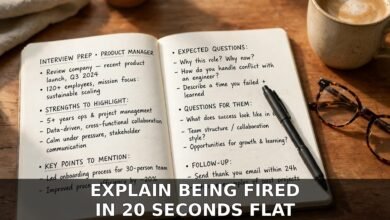
How to Answer ‘Tell Me About a Time You Failed’ in 2026: The Failure-Type-First System That Turns One Mistake Into a Hire


The question lands like a trap. “Tell me about a time you failed.” Your first instinct is to dodge it — to pick something tiny, or something secretly a strength. Don’t: interviewers have heard every version of that dodge, and the dodge is what they remember, not the failure.
Nobody in that room expects a spotless record — they expect a grown-up relationship with mistakes. The candidate who says ‘I missed a deadline, here’s what it cost, here’s what I changed, and here’s the proof it worked’ sounds like someone you can trust. This guide gives you a system, not a script to memorize: sort your failure into one of five types first, then use the matching answer.
The Short Answer
Pick a real failure — real consequences, recoverable, not central to the job you’re applying for. Tell it in about two minutes: a sentence of context, what went wrong and your part in it, what you did to fix it, then spend at least a third of your time on what you learned and what you do differently now, with proof the change worked. Never say you’ve never failed, and never blame the team.
What the Interviewer Is Really Grading
It is not the size of the mistake. Interviewers are grading your relationship with mistakes: do you own your part, do you understand what happened, and have you changed how you work? Every hire is a risk — they want proof that when you mess up, the damage is contained fast and never repeated.
That’s why the “perfect” answers fail. “My biggest failure is that I work too hard” says you either can’t think of a real failure or you’re trying to sell them one — both a lack of self-awareness, the one quality this question tests.
The 3 Pick-Tests: Choose Your Failure First
Most bad answers go wrong before a word is spoken — the wrong failure was picked. Your story has to pass all three of these tests.
Test 1: Is it real? A genuine mistake with a real consequence — a slipped deadline, a let-down customer, a report with an error. If nothing actually went wrong, it isn’t a failure story.
Test 2: Is it recoverable? The damage was contained or fixed — serious enough to be credible, small enough that the interviewer can still picture hiring you.
Test 3: Is it off-center from this job? It must not strike at the heart of the role you want. Applying for a deadline-driven job? Don’t lead with the deadline you blew.
The Failure-Type-First System: 5 Types, 5 Scripts
Most guides hand you STAR and a pile of sample answers. That’s backwards — your answer’s shape should follow your failure’s shape. Sort yours into one of five types first, then use its script.
Type 1: The missed deadline
You promised Friday; it arrived Tuesday.
“I was leading a small project with a Friday deadline, and I didn’t flag early enough that one part was running late. We delivered on Tuesday. I owned it with my manager the same day, and re-sequenced the work so the client got the most important piece on time. Since then I run one rule: if a task is more than a day behind my plan, I raise it that day. Three months later, on a bigger project, we hit every milestone.”
Type 2: The wrong judgement call
You made a call that looked right and turned out wrong.
“Early in my last job I chose a cheaper supplier to save money, without checking their delivery record. The first order arrived two weeks late and we paid rush rates elsewhere. I told my manager straight away, found a backup supplier the same week, and built a short checklist for new suppliers: delivery history, two references, a small trial order first. It has caught two risky suppliers since.”
Name your misjudgement plainly — “I chose,” “I didn’t check.” Ownership is the whole test with this type.
Type 3: The skill gap
You were asked to do something you didn’t yet know how to do — the best type for career changers, because the fix is the story of your growth.
“In my first office job I was asked to build a weekly report in a spreadsheet tool I had barely used. My first version had errors in two columns, caught by my manager before they went out. I asked her to walk me through the formulas, practiced on old data for a week, and rebuilt it. Within a month I was the person new starters came to for help.”
Type 4: The communication miss
Someone needed to know something and you didn’t tell them. These cause the most damage in real workplaces, so interviewers respect a good answer here.
“I was covering a colleague’s shift and a customer changed their order, but I didn’t pass it on properly at handover. The wrong item went out the next morning. I called the customer myself and arranged the replacement the same day. Now I write handovers down instead of relying on memory — a short note, every time. We haven’t had a repeat since.”
The fix is a habit, not a promise: “I write it down now” beats “I’ll be more careful,” because a habit can be checked and a promise can’t.
Type 5: The skipped step
You knew the process and skipped part of it because you were busy or confident.
“I once sent a batch of letters without the final check against the list, because we were rushing to meet the post. Twelve went to old addresses. I flagged it the same afternoon, we re-sent them, and I added a two-minute final check I still use today. It has caught mistakes twice since.”
The Prove-the-Change Test
Whatever your type, your answer is only finished when it passes one more test: can you prove the change stuck? ‘I learned to communicate better’ means very little. ‘I write handovers down now, and we haven’t had a repeat in six months’ means everything.
Spend at least a third of your answer on what you learned and what you do differently now — roughly 40 seconds on the failure, 80 on the fix and the change. Most candidates do the opposite. If the job is remote, the same proof matters twice: a written-update habit shows you can work unseen.
No Experience? Use a School, Part-Time, or Volunteering Story
Never held a full-time job? The same system works — only the setting changes. A group project that missed its deadline, a part-time shift where a handover went wrong, a volunteering rota you mixed up: all real failures, all fit the five types. Keep it in a work, study, or volunteering setting.
5 Answers That Quietly Hurt You
1. “I’ve never really failed.” The self-awareness test, failed on the spot. Everyone has failed — saying otherwise reads as dishonest.
2. The humblebrag. “I failed because I cared too much.” Heard a thousand times. A dodge is worse than a real failure.
3. The blame story. “My manager gave me bad instructions.” Even if partly true, it tells the interviewer you’ll do the same in their team.
4. The disaster. So big the interviewer spends the rest of the interview worrying about it. Too big to lead with.
5. The non-failure. “I once got a B instead of an A.” Trivial stakes, trivial answer. Pick a different story.
Follow-Up Questions to Expect
A good answer invites follow-ups — that’s a good sign. The most common: ‘What would you do differently now?’ (your lesson, already in the answer), ‘How did your manager react?’ (tell the truth — managers respect an early, honest flag far more than a late surprise), and ‘Has it happened again?’ (where your proof pays off). The same sort-first idea helps with the teamwork question — see our guide to answering the teamwork question — and the conflict question guide uses it too.
The 10-Minute Night-Before Drill
Tonight, take ten minutes: write your failure in three lines — what happened, what you did, what changed. Say it aloud once, timed. Past two minutes, cut context, never the lesson. Say it once more, slower, and stop. Then write your second story in two lines. More sounds rehearsed; less and you’ll ramble.
Frequently Asked Questions
How long should my answer to “tell me about a time you failed” be?
About two minutes — 90 seconds to two minutes. Long enough for context, failure, fix, and lesson; short enough to hold attention. Spend at least a third of it on what you learned and what you do differently now.
Should I use the STAR method for this question?
STAR is a good skeleton, but a failure question needs one extra piece: the lesson. Some guides call it STAR+L — Situation, Task, Action (the failure), Action (the recovery), Result and Lesson. The lesson and the proof it stuck matter most, so give them the most time.
What if I have never failed at work?
You have — everyone has. If you can’t think of a work example, use a study, volunteering, or part-time job story. What you must not do is say you have never failed: interviewers read that as a lack of self-awareness, the single worst answer to this question.
Can I talk about being fired?
You can, but only if it passes the three pick-tests — real, recoverable, off-center from the job — and you can tell it in the same calm shape: what happened, your part, the fix, the change. If the firing is recent or central to the role, pick a different failure. Our guide to answering why you left your last job covers the departure conversation in detail.
What is the best failure to talk about in an interview?
A real, recoverable failure outside the job’s core skill, with a clear fix and proof the change stuck. Deadlines, judgement calls, skill gaps, communication misses, skipped steps — pick the type that fits your real story. The guides on what motivates you and where you see yourself in five years use the same match-first approach.
Conclusion
“Tell me about a time you failed” is not a trap — it is an invitation to show the most employable quality there is: someone who makes a mistake, owns it, fixes it, and makes sure it doesn’t happen again. Sort your failure into its type, use the matching 60-second script, and spend at least a third of your answer proving the change stuck. Do that, and the question that scares most candidates becomes the answer that sets you apart. For more preparation in the same style, start with the Remote Jobs guides on JobyRoz.
Build Your Own Website — Free Guidance to Get You Started
Interview answers are really about one thing: presenting yourself well. A business needs the same thing — a place where people can find it, trust it, and contact it. And today, every business needs a website. The good news is that setting one up is far simpler than most people think. You buy hosting through our link, tell the built-in AI about your business, and the AI builds the website for you. No coding, no designer, no weeks of waiting.
 🌐
Free Website
🌐 FREE Website — Turn Your Ideas Into Income
Disclosure: This article contains an affiliate link. If you purchase hosting through it, we may earn a commission at no extra cost to you.
If you want to earn a handsome amount monthly, a website plus helpful articles is one of the most realistic paths there is. Google traffic can turn into monthly income over time — but it takes consistent articles, not overnight magic, and nobody can guarantee earnings. What we can do is help you start properly: buy your hosting through our link, send us your receipt through the JobyRoz contact page, and we will guide your basic business website setup for FREE.
Disclosure: This section contains an affiliate link. If you buy hosting through it, we may earn a commission at no extra cost to you.

The Only Candidate Who Failed the Fetch Test — and Still Got the Job
He dropped the ball. Literally. Then he picked it up, brought it back, and sat down like nothing had happened — because one dropped ball was never the whole story. If your last interview felt like a failed fetch, take the lesson from him: own it, fix it, and show up better next time.
 🐶
Free Pet Guides
Want more loyal lessons like this one?
Visit Earnrove.com for salary and budgeting calculators that help you judge any job offer properly — and visit Clearove.com for simple, practical guides to clean water at home.
🧮Money Tools
Earnrove - Check the Numbers First